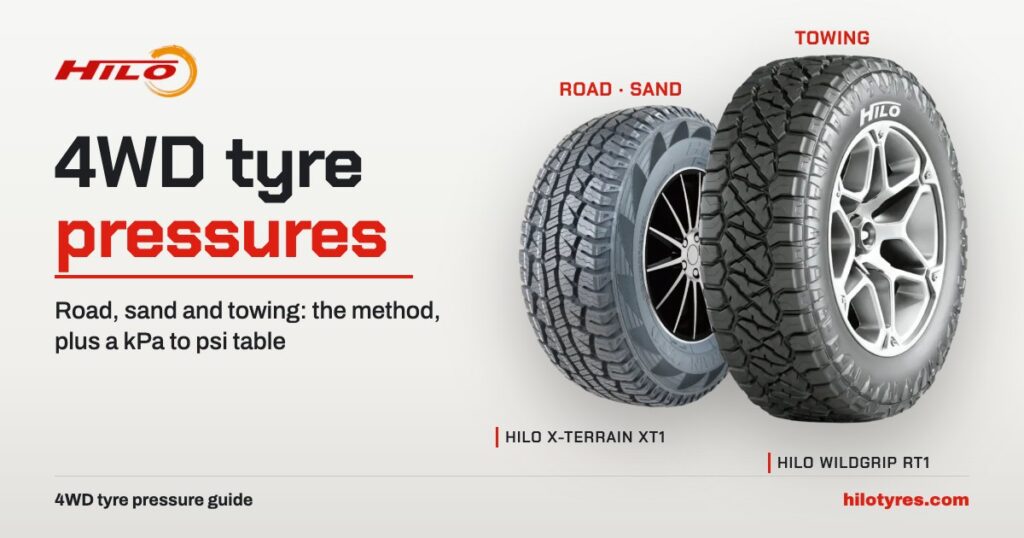
There is no single correct psi for a 4WD. On the road, the right pressure is the cold pressure on the vehicle’s tyre placard or in the owner’s manual, for the tyres the manufacturer specified and the load being carried. On sand, park authorities advise letting air out, driving slower and pumping the tyres back up before returning to normal roads. When towing, start from the vehicle’s and the trailer’s own tyre information.
This guide sets out the method, explains why the number on the sidewall is not the number to use, and gives a kPa to psi conversion table. It is written for tyre shops and workshops, so each section ends with what to tell the customer.
On the road: start with the placard
Transport for NSW says every vehicle built since 1973 has a tyre placard, usually in the glovebox, the engine bay or on a door pillar. The placard sets out the wheel and tyre combinations the manufacturer recommends, along with each tyre’s load capacity, speed rating and recommended inflation pressure. Queensland’s Department of Transport and Main Roads (TMR) adds the driver’s door rail and fuel door as places to look, and the owner’s manual if there is no label.
Correct pressure is also a roadworthiness issue. Transport for NSW’s roadworthiness requirements say tyres, including the spare, must be inflated to the recommended pressure.
Measure cold
TMR’s TyreSmart guidance defines cold tyres as ones on a vehicle that has been stationary for at least three hours or has been driven no more than 2 km. It recommends checking at least once a month with a good-quality gauge, because you cannot judge pressure by looking at a tyre. Check all the tyres, including the spare.
If the nearest air is more than 2 km away, TMR suggests taking a reading at home, driving to the pump, taking a second reading, then filling to the recommended pressure plus the amount that was missing at home.
The sidewall maximum is not your road pressure
The maximum pressure moulded on the sidewall is the pressure needed for the tyre to carry its maximum load. TMR notes that it is not always the same as the vehicle manufacturer’s recommended pressure. This matters on 4WDs because light truck (LT) tyres list high maximums. In HILO’s X-TERRAIN XT1 table, for example, the 10-ply LT sizes list a maximum of 550 kPa (80 psi). That figure is a limit, not a target.
What to tell the customer: “Use the placard figure for this vehicle, check it cold, and check the spare too.” Pointing to the placard on their own door pillar is quicker than any explanation.
When the tyres are not the placard tyres
The placard figure applies to the tyres the vehicle manufacturer specified. A 4WD may now be running something else: LT construction instead of passenger, a taller size, or both. Once that happens, the placard pressure may not suit the fitted tyre.
In that case, work from the fitted tyre’s load and pressure data and the vehicle’s axle loads, or ask the tyre manufacturer. Transport for NSW refers people who need more technical tyre information to the Tyre and Rim Association of Australia’s annual Standards Manual. Our sidewall guide explains the load index and speed symbol you will need for that conversation.
What to tell the customer: if you fit tyres that differ from the placard, write down the pressure you set and why, and tell them the placard figure no longer applies to those tyres.
On sand: let air out, slow down, pump back up
Lower pressure helps a tyre conform to soft ground. Our mud-terrain guide for the X-TERRAIN MT1 explains the trade-off: reducing pressure in suitable off-road conditions may increase the contact area, while excessive deflation increases heat and sidewall flex and raises the risk of the bead becoming unseated.
Park authorities publish similar advice for their own tracks. Western Australia’s Parks and Wildlife Service, in its Francois Peron National Park visitor guide, tells drivers to:
- deflate the vehicle’s tyres before driving on soft sand, and the trailer’s tyres too if towing;
- expect the right pressure to vary with vehicle type and load, and with the type of tyre and rim;
- drive at lower speeds whenever tyres are deflated;
- keep four-wheel drive engaged on sandy tracks, and brake gently to a rolling stop rather than braking suddenly;
- reinflate the tyres when returning to two-wheel-drive roads.
Some parks, Francois Peron among them, publish a pressure figure for their tracks and provide a tyre pressure station. Follow the local guidance for the park you are visiting, and stay within any limits the vehicle or tyre manufacturer sets. Treat a park figure as a starting point: the right pressure also depends on the vehicle’s weight, the tyre’s construction and the rim.
What to tell the customer: carry an accurate gauge, suitable inflation equipment and an inspected spare, as our MT1 guide recommends. Before getting back up to sealed-road speed, check the tyres for cuts and lodged debris and reinflate to the road pressure.
Towing and heavy loads
A loaded 4WD or a 4WD towing a van is carrying more weight on its tyres, so the road pressure question becomes more important, not less.
- The tow vehicle: if the placard or owner’s manual gives a separate figure for heavier loads, use it. If it does not, ask the vehicle manufacturer or a tyre professional rather than guessing.
- The trailer or caravan: its tyres have their own requirements. Use the trailer or caravan manufacturer’s tyre information, not the tow vehicle’s placard.
- Load rating: Transport for NSW requires replacement tyres to have a load rating equal to or higher than the original tyres. Check the full load index before blaming pressure for a tyre that is struggling.
What to tell the customer: check pressures cold before the trip, not at the first fuel stop, and check the van’s tyres as well as the vehicle’s.
kPa to psi conversion table
Placards such as the example in TMR’s TyreSmart brochure give pressures in kPa, while some gauges and compressors read psi. One psi equals 6.894757 kPa, so divide kPa by 6.895 to get psi, or multiply psi by 6.895 to get kPa. This table converts values; it is not a list of recommended pressures.
| kPa | psi | kPa | psi |
|---|---|---|---|
| 100 | 14.5 | 220 | 31.9 |
| 120 | 17.4 | 240 | 34.8 |
| 140 | 20.3 | 260 | 37.7 |
| 160 | 23.2 | 280 | 40.6 |
| 180 | 26.1 | 300 | 43.5 |
| 200 | 29.0 | 350 | 50.8 |
For the LT maximums that appear in HILO’s specification tables: 450 kPa is 65.3 psi and 550 kPa is 79.8 psi.
When to send the customer to a tyre professional
- A tyre keeps losing pressure between checks.
- After a day at low pressure, there is a cut, crack, blister or bulge. TMR says tyres with deep cuts, cracks, blisters and bulges are dangerous and should be replaced.
- The tread shows uneven wear. TMR notes that an overinflated tyre runs on the centre of the tread, which reduces grip and increases wear.
- The vehicle now runs different tyres from those on the placard, and nobody has set pressures for them.
Ordering for your workshop
If your customers are moving to LT or larger 4WD tyres, compare the full specification on the HILO SUV and 4×4 range and send the exact pattern, size, load index, speed symbol and ply rating through the HILO trade enquiry form.
Frequently asked questions
What psi should 4WD tyres be on the road?
The cold pressure on the vehicle’s tyre placard or in the owner’s manual, for the tyres the manufacturer specified. If the vehicle runs different tyres, ask a tyre professional to set pressures from the fitted tyre’s load data.
What tyre pressure should I use for a 4WD on sand?
Lower than road pressure, but how much lower depends on the vehicle, its load, the tyre and the rim. Follow the park’s own guidance, drive slower while deflated, and reinflate before returning to normal roads.
Why does my tyre say 80 psi when the placard says much less?
The sidewall figure is the maximum pressure, needed only to carry the tyre’s maximum load. It is not the recommended running pressure for your vehicle.
How do I check tyre pressure properly?
Measure cold, after the vehicle has stood for three hours or been driven less than 2 km, with a good-quality gauge. Check all tyres including the spare, at least once a month.
How many kPa is 30 psi?
About 206.8 kPa. Multiply psi by 6.895 to get kPa.