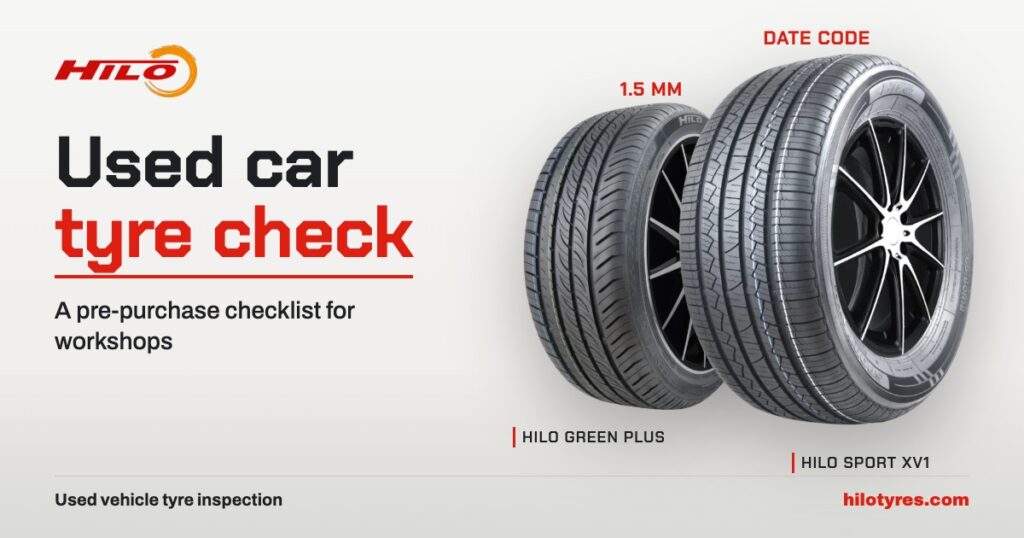
To inspect the tyres on a used vehicle, check every tyre, including the spare, for five things: tread depth (the legal minimum is 1.5 mm), how evenly the tread has worn, damage to the sidewalls, the date the tyre was made, and whether the size and ratings match the vehicle’s tyre placard. Then check the pressures and confirm what you found on the test drive. Worn or mismatched tyres are a cost the buyer will meet soon after the sale, and uneven wear can point to alignment, balance or pressure problems the seller may not mention.
This checklist is written for workshops and tyre shops doing pre-purchase inspections. Each section ends with what to tell the customer, and there is a one-page checklist at the end you can copy onto a job card.
1. Tread depth: is it above the legal limit?
The NSW Government’s roadworthiness rules say tyres, including the spare, “must not be smooth and must have a tread at least 1.5mm deep”. They must also be inflated to the recommended pressure and must not have cracks or bumps or be worn unevenly. Each state and territory publishes its own roadworthiness rules, so check the local transport authority if the vehicle is registered interstate.
Measure in the right place. The National Heavy Vehicle Inspection Manual explains that tread depth should be measured in the principal grooves, not the shallower secondary grooves, which can disappear through normal wear. Most tyres also have tread wear indicators in the principal grooves that show when tread depth reaches about 1.5 mm.
- Take readings in a principal groove across the tyre (inner, centre, outer) and at a few points around it.
- Note whether the tread is level with the wear indicator bars. If it is, the tyre is at the limit.
- Don’t treat 1.5 mm as a target. Queensland’s Department of Transport and Main Roads (TMR) advises in its TyreSmart guidance: “Replace your tyres before they reach the minimum depth.”
What to tell the customer: tyres close to the limit are not a reason to walk away from a good vehicle, but they will need replacing soon, before they reach the minimum. Give them the measured depths so they can factor a new set into their offer.
2. Read the wear pattern
How a tyre has worn tells you how the vehicle has been maintained. Look across the full width of each tread.
| What you see | What it can point to |
|---|---|
| More wear in the centre than at the edges | Tyres run over-inflated. TMR notes an over-inflated tyre touches the road mainly on the centre of the tread, which increases wear. |
| Heavy wear along the edges | Poor wheel alignment. TMR lists “excessive wear on the edges of your tyres” as a common alignment symptom. Low pressure is also worth checking. |
| Bald patches or scalloped spots | Wheels out of balance. TMR says this can lead to uneven tyre wear (bald spots). |
| Front tyres more worn than the rears, or the reverse | Normal to a degree, especially on front-wheel drive vehicles. A big difference suggests the tyres haven’t been rotated. |
Confirm it on the test drive. TMR lists steering that pulls to one side and shuddering at high speeds as common signs of poor alignment, and a pounding or shaking through the steering wheel or seat as a sign of wheels out of balance.
What to tell the customer: if the wear is clearly uneven, the cause needs fixing before or with new tyres. Otherwise the new set will wear the same way.
3. Sidewalls and tread surface: cuts, cracks and bulges
TMR’s advice is direct: “Tyres with deep cuts, cracks, blisters and bulges are dangerous and should be replaced.” Check both sidewalls of every tyre. On the front tyres, turn the steering to full lock to see the inner sidewalls.
- Bulges or bubbles in the sidewall
- Cuts or gouges, especially any deep enough to show cords or wire
- Cracking or perishing in the rubber
- Nails, screws or stones lodged in the tread
What to tell the customer: list each damaged tyre by position on the report, and price the replacement into the deal.
4. Check how old the tyres are
The date of manufacture is moulded into the sidewall as a four-digit code. Transport for NSW’s guidelines for alternative wheels and tyres give the example “3015”, which means week 30 of 2015. If it isn’t on the outer sidewall, look on the inner side.
Age matters because rubber deteriorates over time, even on a low-kilometre vehicle with deep tread. SafeWork NSW lists “perishing on tyres more than five years old” among the defects to check for before a tyre is fitted. Look closely at older tyres for cracking. Mixed dates across the four tyres are worth a question too, because they can mean tyres were replaced one at a time.
What to tell the customer: record the date code of each tyre on the report. It’s a fact they can check themselves and raise with the seller.
5. Match the tyres to the tyre placard
Transport for NSW explains that all vehicles built since 1973 have a tyre placard, usually in the glove box, the engine bay or on a door pillar. It lists the wheel and tyre combinations the manufacturer recommends, with load capacity, speed rating and recommended inflation pressure. TMR notes the label is generally inside the driver’s door, on the door frame.
- Size. Read the size off each tyre and confirm it’s a size listed on the placard. Our sidewall guide explains each part of the marking.
- Load rating. Transport for NSW says replacement tyres must have a load rating equal to or higher than the original tyres.
- Speed rating. It should be equal to or higher than the original. If lower-rated tyres are fitted, Transport for NSW recommends a warning label be fixed to the vehicle.
- Matching on each axle. Transport for NSW says: “Never mix tyre types or sizes on an axle, unless when using an emergency spare tyre.” TMR advises the same type of tyre on all four wheels for proper handling.
- Retreads. Retreaded tyres must be marked “RETREAD” or “REMOULD”, with the retreader’s identity, the retread date and the speed limit.
- Run-flats. If the vehicle came with run-flat tyres, check whether the fitted tyres still are. Our run-flat guide covers what to confirm before replacing them with standard tyres.
Modified 4WDs and utes
Larger tyres change more than looks. In NSW, the same Transport for NSW guidelines note that fitting replacement tyres that increase or decrease the overall diameter by more than 7% of the original requires a compliance certificate from a licensed certifier. Our guide to 33-inch and 35-inch tyres shows the metric sizes behind common upgrades. Transport for NSW also warns that changes outside the placard may void insurance cover or the manufacturer’s warranty.
What to tell the customer: ask the seller for any certification paperwork, and check with their insurer. Rules differ between states, so they should confirm with their own transport authority.
6. Don’t forget the spare
The NSW roadworthiness rules include the spare, and TMR reminds drivers to “always check the spare tyre too”. Check it’s there, inflated and in reasonable condition. If it’s a space-saver, it will be marked “TEMPORARY USE ONLY”. Transport for NSW notes these are for emergencies only, for as short a distance as possible, and are typically rated to a maximum of 80 km/h.
7. Check the pressures
Pressures are most accurate when the tyres are cold. TMR defines this as a vehicle that has been stationary for at least three hours or has not been driven more than 2 km. Compare each reading with the placard. One tyre much lower than the others can mean a slow leak.
What to tell the customer: a tyre that keeps losing pressure needs a proper inspection, not just topping up.
Used vehicle tyre checklist
- Tread depth in the principal grooves, across and around each tyre: above 1.5 mm and clear of the wear indicators.
- Wear pattern: even across the tread, with no centre, edge or patchy wear.
- Sidewalls: no cuts, cracks, bulges or exposed cords, inside and out.
- Date code: recorded for each tyre, with older tyres checked closely for cracking.
- Placard match: size, load rating and speed rating, with matching tyres on each axle.
- Spare: present, inflated and in good condition.
- Pressures: close to the placard figure when cold.
- Test drive: no pulling, shuddering or vibration.
Quoting replacements
When the inspection turns up tyres that need replacing, note the full description from the placard and the existing tyres: size, load index, speed symbol and, for 4WDs, construction. Use the HILO size finder to see which patterns come in that size, compare them across the HILO range, and send the exact specification through the HILO trade enquiry form.
Frequently asked questions
What is the minimum legal tread depth for car tyres?
1.5 mm. The NSW Government’s roadworthiness rules say tyres, including the spare, must not be smooth and must have a tread at least 1.5 mm deep. Measure it in the principal grooves. Other states publish their own rules, so check the local transport authority.
How do I check the tyre size on a used car?
Read the size printed on each tyre’s sidewall and compare it with the tyre placard, usually found in the glove box, the engine bay, on a door pillar or inside the driver’s door frame. Every tyre should be a size the placard lists.
How can I tell how old a tyre is?
Find the four-digit date code on the sidewall. The first two digits are the week and the last two are the year, so “3015” means week 30 of 2015. Check the inner sidewall if it isn’t on the outside.
Do all four tyres on a used car need to match?
Tyres on the same axle must not be mixed by type or size, except for an emergency spare. Queensland’s TMR advises the same type of tyre on all four wheels for proper handling, and every tyre should be a size listed on the placard.
Is uneven tyre wear a problem when buying a used car?
It can be. Uneven wear can point to incorrect pressure, poor wheel alignment or wheels out of balance, and NSW rules say tyres must not be worn unevenly. Have the cause checked before buying, or new tyres may wear the same way.