All-terrain (A/T) tyres are generally the more balanced choice for 4WDs that combine daily sealed-road driving with gravel and touring. Rugged-terrain (R/T) tyres sit between A/T and mud-terrain patterns, using a more aggressive tread for drivers who encounter deeper ruts, rocks and loose surfaces more often. The right choice depends on real terrain use, acceptable road trade-offs and correct vehicle fitment.
If you are comparing rugged-terrain vs all-terrain tyres, begin with one question: how often does your 4WD genuinely leave maintained roads?
R/T vs A/T tyres: the quick comparison
| Consideration | All-Terrain (A/T) | Rugged-Terrain (R/T) |
|---|---|---|
| Main role | Mixed sealed and unsealed driving | A more off-road-biased middle ground |
| Daily commuting | Usually the more balanced category | Possible, but tread is more aggressive |
| Gravel roads | Well suited | Well suited |
| Rocks and deeper ruts | Moderate capability | Typically the more off-road-focused option |
| Mud | Light to moderate, pattern dependent | Usually more open than A/T, but not the same as M/T |
| Pattern noise | Typically lower | May be more noticeable |
| Weight and rolling resistance | Often lower | May increase with aggressive LT fitments |
R/T is a market category rather than one universal performance standard. Different manufacturers can use the label for tread patterns with different constructions and on-road behaviour, so always compare the actual products and sizes.
What is an all-terrain tyre?
An all-terrain tyre is designed to balance sealed-road use with gravel, dirt and moderate off-road driving. It normally has a more open tread than a highway-terrain tyre but remains less aggressive than a typical R/T or M/T pattern.
An A/T tyre is commonly considered by drivers who:
- use their 4WD for daily commuting;
- travel long highway distances;
- regularly drive on gravel roads;
- tow or tour on mixed surfaces; or
- need more off-road capability than a road-focused SUV tyre.
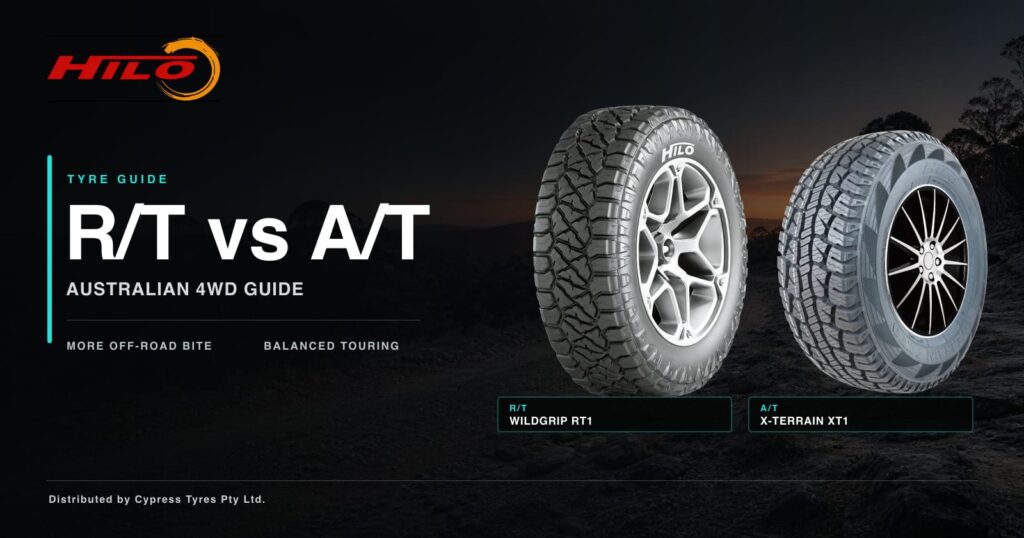
The HILO X-TERRAIN XT1 is HILO’s current SUV A/T example. HILO describes it as an all-terrain pattern for sealed roads and gravel, using an open shoulder design and four curved grooves intended to support traction and self-cleaning on irregular surfaces.
The current Australian product page lists P-metric, commercial and LT fitments across 15- to 20-inch wheels. Exact load index, speed symbol, ply rating and availability vary by size.
What is a rugged-terrain tyre?
A rugged-terrain tyre is generally positioned between A/T and M/T designs. It uses a more aggressive block and shoulder layout than a typical A/T, while aiming to retain more sealed-road usability than a dedicated mud-terrain tyre.
R/T tyres are commonly considered for:
- rocky tracks;
- deeper wheel ruts;
- loose surfaces;
- work-site access;
- touring vehicles that spend substantial time off-road; and
- drivers who need more tread aggression than an A/T but do not require a full M/T.
The HILO WILDGRIP RT1 is classified as an SUV R/T pattern. HILO positions it between all-terrain and mud-terrain use, with an off-road emphasis. This positioning is not a measured noise comparison with an A/T or M/T.
Its current Australian product page lists 24 sizes from 15 to 20 inches, including flotation and LT fitments with ply ratings up to 10PR. Current local stock still needs to be confirmed with the distributor or stockist.
Choose an A/T tyre if…
An A/T tyre is likely to be the better starting point when:
- sealed roads account for most kilometres;
- gravel roads and maintained tracks are the main off-road surfaces;
- the vehicle is used for long-distance touring;
- road comfort and pattern noise remain important; and
- you want one balanced set of tyres for commuting and weekend use.
This does not mean every A/T tyre will be quiet, economical or strong in the wet. Those results depend on the individual pattern, compound, size, construction, pressure and vehicle.
Choose an R/T tyre if…
An R/T tyre becomes more relevant when:
- difficult tracks are a regular part of the vehicle’s use;
- you frequently encounter loose rock, ruts or rough work-site surfaces;
- an A/T pattern does not provide enough off-road emphasis;
- a dedicated M/T would introduce more on-road compromise than you need; and
- you accept that a more aggressive tread may affect noise, weight, wear or fuel use.
Choosing an R/T mainly for appearance can leave a vehicle carrying unnecessary trade-offs on every sealed-road trip. Match the tyre to the hardest terrain you use regularly, not the most extreme terrain you can imagine.
Identify the two patterns
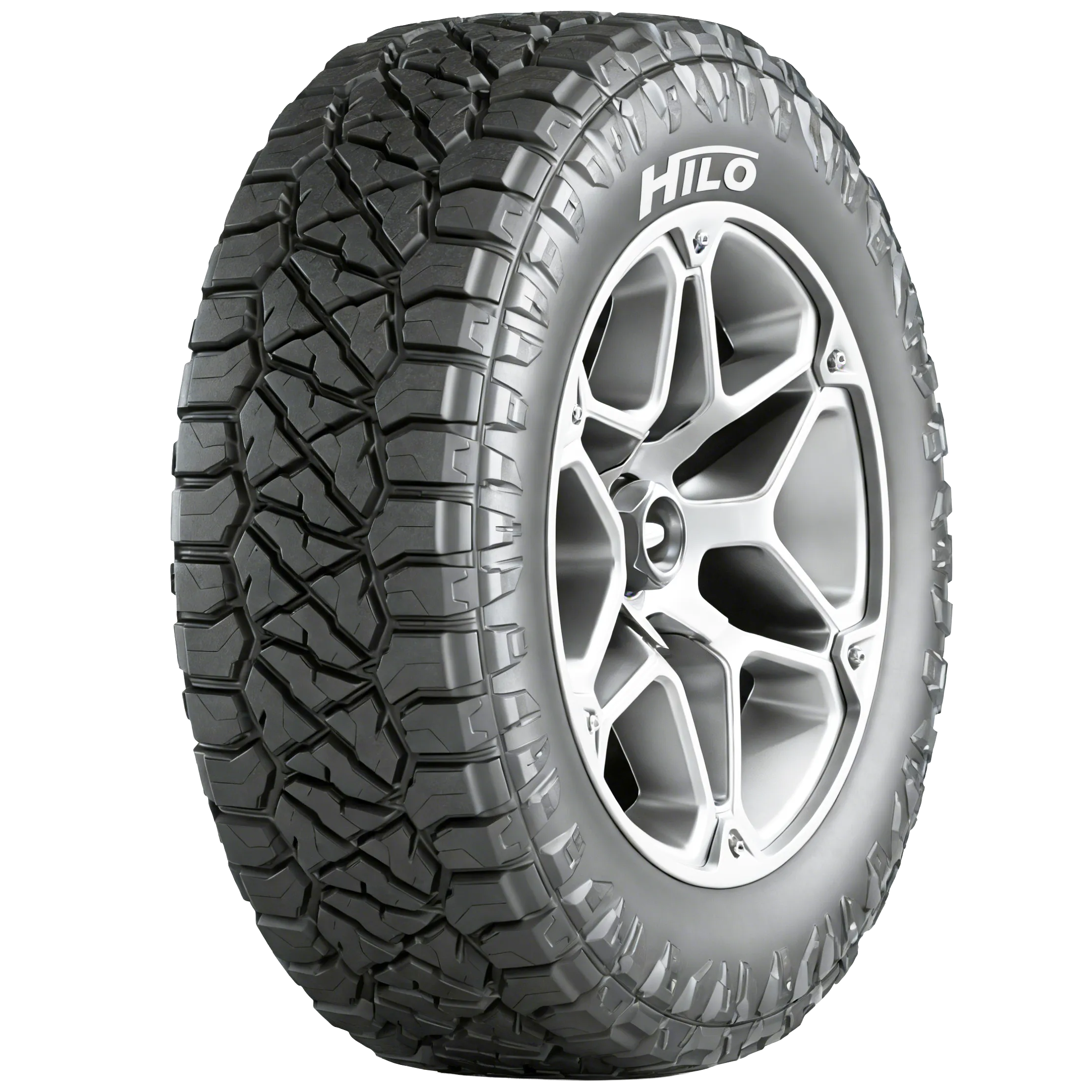
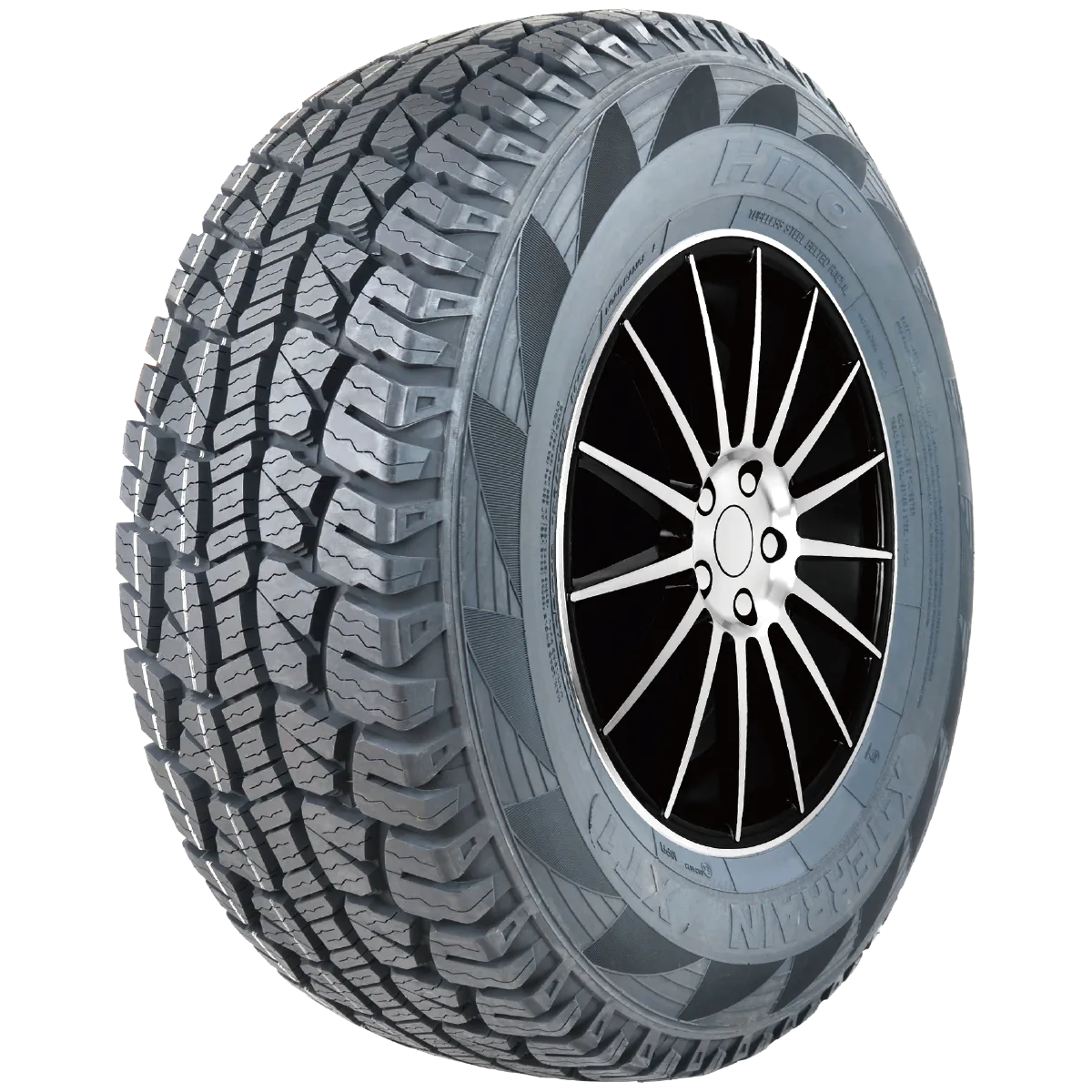
Image-source check: 21 September 2026. Use the full catalogue entry for load, speed and construction details. Do not infer measured braking, noise or durability from the tread illustration.
HILO WILDGRIP RT1 vs X-TERRAIN XT1: published specifications
The RT1 is listed as SUV R/T and the XT1 as SUV A/T. Both published ranges cover 15–20-inch wheels. The examples below show why a nominal size alone is not enough to order: load index, speed symbol, XL designation and ply rating can differ.
| Nominal size | WILDGRIP RT1 | X-TERRAIN XT1 |
|---|---|---|
| 265/65R17 | 265/65R17 (RWL): 116Q XL; ply rating —; listed standard rim 8J; overall diameter 776 mm | 265/65R17: 112T; ply rating —; listed standard rim 8J; overall diameter 776 mm |
| 265/70R17 | 265/70R17 (RWL): 115Q; ply rating —; listed standard rim 8J; overall diameter 804 mm | 265/70R17: 115T; ply rating —; listed standard rim 8J; overall diameter 804 mm |
| 265/60R18 | 265/60R18 (RWL): 114Q XL; ply rating —; listed standard rim 8J; overall diameter 775 mm | 265/60R18: 110T; ply rating —; listed standard rim 8J; overall diameter 775 mm |
| LT285/75R16 | LT285/75R16 (RWL): 126/123Q; ply rating 10PR; listed standard rim 8J; overall diameter 834 mm LT285/75R16 (RWL): 116/113Q; ply rating 6PR; listed standard rim 8J; overall diameter 834 mm |
LT285/75R16: 121/118Q; ply rating 10PR; listed standard rim 8J; overall diameter 834 mm |
Source: the WILDGRIP RT1 specification tables and X-TERRAIN XT1 specification tables, which identify HILO catalogue 2025.12, Shandong Xinghongyuan Tire Co., Ltd as their source. Website values checked on 21 September 2026. These are selected catalogue entries, not confirmation of current Australian stock or approved vehicle fitment.
For LT285/75R16, the RT1 table lists two different load/ply variants. Specify the complete entry when asking for a quote. A listed standard rim is a catalogue measurement reference; it is not a complete approved rim-width range. A dash means the table does not state a value.
Performance evidence: this guide does not have a matched independent RT1-versus-XT1 test for wet braking, cabin noise, puncture resistance or tyre life. Catalogue dimensions and category labels do not establish a winner on those measures.
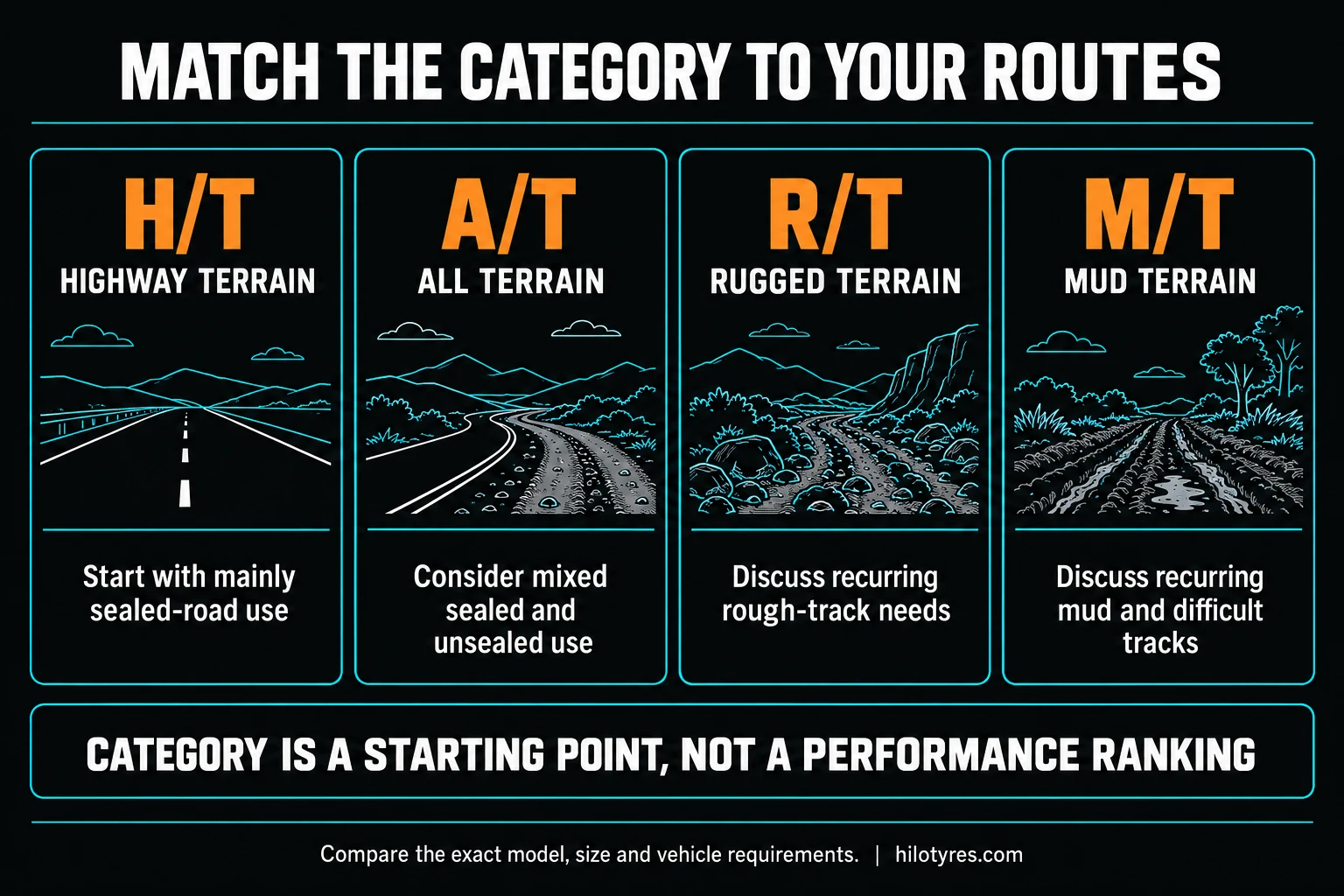
H/T starts with mainly sealed-road use; A/T considers mixed sealed and unsealed routes; R/T considers recurring rough access tracks; M/T considers recurring mud and ruts. Describe the actual route and loads, then compare compatible models. Category names do not establish braking, noise or durability performance.
Three route cards to take to your fitter
Daily commuting with occasional maintained gravel
Record the roads you actually drive, how often you leave sealed surfaces, and what you want to improve about your present tyres. Start the discussion with the road-focused or all-terrain options; ask what an R/T would add for your particular route before choosing it.
Regular gravel touring and rough access tracks
Describe the surface, typical journey length, passengers, luggage and any towing. Compare the full specifications of compatible A/T and R/T options. Ask for model-specific evidence if quietness, wet braking or damage resistance is important to you.
Recurring mud, ruts or difficult tracks
Describe the actual obstacles and how much sealed-road travel connects them. Include an M/T option in the discussion using the HILO MT1 guide. A terrain label alone does not determine whether a tyre or vehicle can safely negotiate a track.
How does an R/T tyre behave on sealed roads?
An R/T tyre can be driven on sealed roads when it is correctly fitted and used within its specifications. However, the larger blocks and wider voids typical of the category can make pattern noise, steering feel and rolling resistance more noticeable than with a road-oriented A/T.
The effect varies with:
- tyre size and construction;
- tread design;
- vehicle weight;
- inflation pressure;
- wheel alignment;
- road surface; and
- tread wear.
Drivers spending nearly all their time in cities or on motorways should consider whether the additional off-road tread is genuinely useful.
Are R/T tyres better in mud?
An R/T pattern will often have a more open tread than an A/T, which may help it clear loose material. That does not make every R/T a dedicated mud tyre.
If deep mud, clay and low-range technical tracks are the main use, compare a purpose-built M/T pattern as well. The existing HILO X-TERRAIN MT1 mud-terrain guide explains the more aggressive end of the category and its sealed-road trade-offs.
In simple terms:
- A/T: mixed daily, gravel and touring use;
- R/T: more aggressive mixed use with greater off-road emphasis;
- M/T: dedicated mud and technical-terrain priority.
Does LT construction mean better off-road performance?
LT is not a terrain category. It identifies a Light Truck-type size or construction designation and is commonly associated with higher load-carrying applications and different casing characteristics.
An LT tyre may suit some touring, towing and work vehicles, but it can also add weight and alter ride characteristics. Do not choose LT construction only because it appears more rugged.
Check:
- the vehicle tyre placard;
- required load index and speed symbol;
- operating load;
- wheel compatibility;
- recommended inflation pressure; and
- advice from a qualified tyre professional.
The numbers and letters following the tyre size are just as important as the A/T or R/T category.
What should you check before changing tyre size?
Before fitting a different size or construction, confirm:
- Load index and speed symbol meet the vehicle manufacturer’s requirements.
- Wheel width and diameter are compatible with the tyre.
- Steering and suspension clearance remain adequate throughout their travel.
- Overall rolling diameter does not create unacceptable effects on the speedometer, gearing, braking or driver-assistance systems.
- State or territory requirements are satisfied.
The appearance of an R/T or A/T tyre does not confirm legal or mechanical compatibility.
Frequently asked questions
What does R/T mean on a tyre?
R/T generally means rugged terrain. It is commonly used for tyres positioned between A/T and M/T patterns, with more aggressive tread than a typical all-terrain tyre. Because there is no single universal R/T performance standard, compare the exact model and size rather than relying on the label alone.
Are rugged-terrain tyres louder than all-terrain tyres?
They can be. Larger blocks and wider voids may create more pattern noise, but the result depends on the tyre model, size, pressure, vehicle and road surface. It is safer to describe additional noise as a possible trade-off rather than assume every R/T will be louder than every A/T.
Are R/T tyres suitable for daily driving?
An R/T tyre can suit a daily-driven 4WD when the vehicle also encounters demanding off-road conditions regularly. If almost all kilometres are on sealed roads, an A/T or H/T tyre may provide a more appropriate balance of road comfort and capability.
Are R/T tyres better than A/T tyres in mud?
An R/T’s more open tread may provide additional capability in loose or muddy conditions, but performance varies by pattern and pressure. For frequent deep mud and technical tracks, a dedicated M/T tyre should also be considered.
What is the difference between R/T and M/T tyres?
R/T tyres aim to bridge the gap between A/T and M/T use. M/T tyres place a stronger priority on deep mud, large voids and technical off-road traction, usually with greater sealed-road compromises. R/T tyres are intended to retain a broader mixed-use role.
Should I choose LT construction for my 4WD?
Only when it suits the vehicle, load and use. LT construction can be relevant to towing, touring and work applications, but the correct decision depends on load index, pressure, wheel compatibility, vehicle placard requirements and professional fitment advice.
What to send a stockist before choosing
Prepare your vehicle make, model and year; the complete current tyre size and service description; vehicle placard requirements; normal loads and towing; route details; and your suburb or postcode. Include the exact pattern and catalogue variant if you have one in mind. A fitter must confirm compatibility before installation.
For fitting enquiries, ask for a HILO stockist. Tyre shops and fleet buyers can request HILO trade supply with quantities, delivery postcode and required timing.
Compare the HILO 4×4 range
Choose an A/T when balanced mixed-surface driving is the priority. Consider an R/T when rougher tracks are a routine part of the vehicle’s use and an A/T no longer provides enough off-road emphasis.
Compare the HILO X-TERRAIN XT1 with the HILO WILDGRIP RT1, or browse the complete HILO tyre range. For current Australian availability, use the HILO stockist enquiry service.
HILO tyres are officially distributed in Australia by Cypress Tyres.