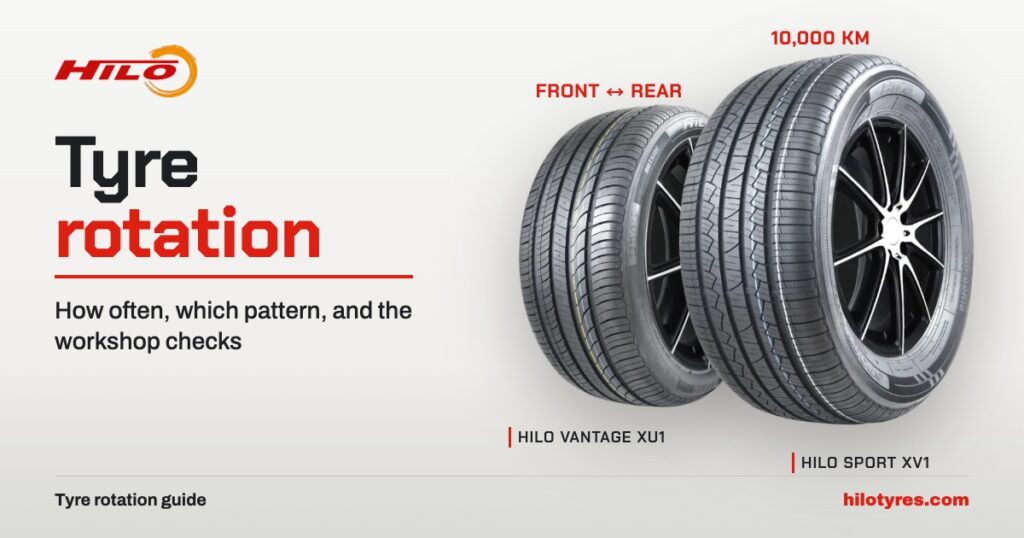
Tyre rotation means moving each wheel to a different position on the vehicle so the tyres wear more evenly and last longer. How often to rotate is set by the vehicle manufacturer and listed in the owner’s manual. Queensland’s Department of Transport and Main Roads (TMR) says it is normally every 10,000 km. Which pattern to use depends on the tyres: directional tyres can only move front to back on the same side, while most non-directional tyres can also cross sides.
This guide is for workshops and tyre shops. It covers the interval, how to identify the tread type, the common patterns, and the checks to do while the wheels are off. Each section ends with what to tell the customer.
Why rotate tyres at all?
Each wheel position does a different job. The front tyres steer, and on a front-wheel drive vehicle they also put the power down. TMR’s TyreSmart guidance notes that “front and back tyres usually wear differently, especially on front wheel drive vehicles” and that tyres will last longer if they are rotated regularly. Moving them around spreads the wear across the set, so the customer is less likely to be replacing one axle well ahead of the other.
Rotation spreads wear. It does not fix the cause of uneven wear. If a tyre is wearing on one edge, check the alignment and pressures first.
What to tell the customer: regular rotation helps all four tyres wear out together, which usually means replacing a full set at once rather than buying pairs at odd times.
How often should tyres be rotated?
- Follow the owner’s manual. TMR’s advice is to rotate “according to the vehicle manufacturer’s recommendation, found in the owner’s manual”.
- If there’s no figure to hand, TMR says the interval is normally every 10,000 km.
- Tie it to servicing. Doing it at each scheduled service makes it easy for the customer to keep up.
- Look at the tyres between rotations. If one axle is wearing much faster or a tyre shows uneven wear, investigate rather than wait for the next interval.
What to tell the customer: write the next rotation due (date or odometer reading) on the invoice or a windscreen sticker.
Step one: identify the tread type
The pattern you can use depends on the tread design and whether all four tyres are the same size. Transport for NSW’s guidelines for alternative wheels and tyres describe three tread types:
| Tread type | How to recognise it | Where it can move |
|---|---|---|
| Directional | Arrows on the sidewall show the direction of rotation. The tread usually forms a V shape. | Between front and rear axles, but on one side only. |
| Symmetrical | Same pattern on the inner and outer half of the tread. | Any position: either side, front or rear. |
| Asymmetrical | Different patterns on the inner and outer tread. The sidewall is marked “Outside”. | Any position, as long as the side marked “Outside” faces outwards. |
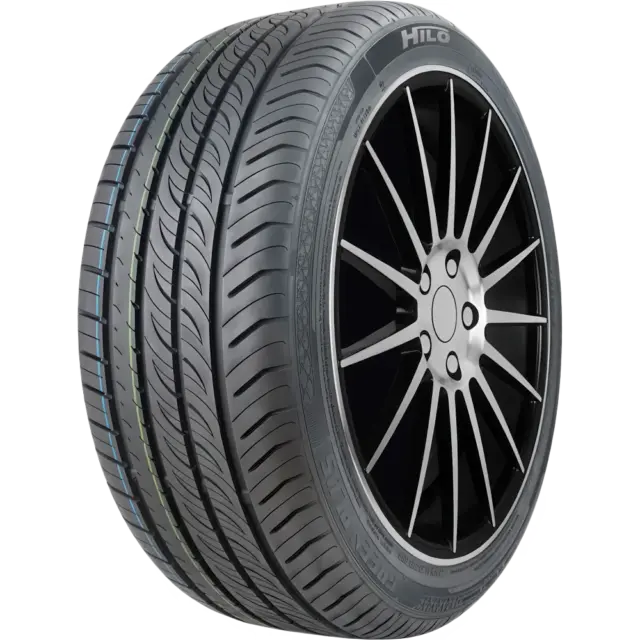
In the HILO range, for example, the VANTAGE XU1 uses an asymmetric tread, with a fine inner pattern for grip and a large outer block for ground contact in corners. Always confirm from the sidewall markings on the tyre in front of you.
Then check the tyre placard (usually in the glove box, the engine bay, on a door pillar or inside the driver’s door frame). If it lists different sizes for the front and rear, the vehicle has a staggered set-up, which limits the options (see below).
Common tyre rotation patterns
Front to back (same side)
The front left swaps with the rear left, and the front right swaps with the rear right. This is the pattern for directional tyres, because they must keep rolling in the direction of the arrows. It also works for any other tyre when all four are the same size.
Cross patterns
For symmetrical and most asymmetrical tyres, a cross pattern moves tyres both between axles and between sides, which evens out wear further. There are two common versions:
- Rearward cross: the rear tyres move straight forward to the front on the same side, and the front tyres cross to the opposite sides at the rear.
- Forward cross: the front tyres move straight back on the same side, and the rear tyres cross to the opposite sides at the front.
Which cross suits a vehicle depends on the drivetrain and the manufacturer’s advice, so check the owner’s manual.
Side to side (staggered set-ups)
Transport for NSW says tyre types or sizes must never be mixed on an axle, and every tyre must be a size the placard allows for its position. On a vehicle with different front and rear sizes, tyres can’t move between axles. With non-directional tyres, you may be able to swap left and right on the same axle. With directional tyres on a staggered set-up, rotation generally isn’t possible without remounting the tyres on the rims.
Five-tyre rotation (4WDs and utes with a full-size spare)
Some 4WD and ute owners include a full-size spare in the rotation so that five tyres share the wear. This only works if the spare matches the other four in size, type and construction, because tyres can’t be mixed on an axle, and the spare needs to be in comparable condition. On LT 4WD tyres, construction matters as much as size: our R/T vs A/T guide explains what to check. Never put a space-saver into a rotation. It is marked “TEMPORARY USE ONLY”, and Transport for NSW notes it is for emergencies, over as short a distance as possible.
What to tell the customer: if they want a five-tyre rotation, the spare has to match the other four. When fitting a new 4WD set, quote five tyres, not four.
Rotation checklist for the workshop
- Inspect every tyre while the wheels are off. Look for cuts, cracks, blisters and bulges, which TMR says should mean replacement, and note any uneven wear.
- Record tread depths by position before moving anything, so the next rotation can be compared against this one.
- Move the wheels using the right pattern for the tread type and set-up.
- Tighten the wheel nuts to the manufacturer’s specification. TMR notes the correct wheel nut tightness is in the owner’s manual.
- Set each tyre’s pressure to the placard figure for its new position, with the tyres cold.
- Check the tyre pressure monitoring system if the vehicle has one. The owner’s manual will say whether it needs resetting after a rotation.
- Recommend an alignment check if it’s due. TMR suggests having alignment checked at least once a year.
When rotation isn’t the answer
- A tyre is close to the legal minimum tread depth of 1.5 mm, which the NSW Government’s roadworthiness rules set, or level with its wear indicators.
- A tyre is damaged or shows cracking.
- Wear is badly uneven because of an alignment, balance or pressure problem that hasn’t been fixed.
In those cases the tyre needs replacing or the cause needs fixing. Use our sidewall guide to read the full specification off the old tyre, check which patterns come in that size with the HILO size finder, and send the exact pattern, size, load index and speed symbol through the HILO trade enquiry form.
Frequently asked questions
How often should tyres be rotated?
As the vehicle manufacturer recommends in the owner’s manual. Queensland’s TMR says this is normally every 10,000 km. Check the tyres between rotations too, and have uneven wear looked at straight away.
Can you rotate directional tyres?
Yes, but only between the front and rear on the same side of the vehicle, so they keep rolling in the direction of the sidewall arrows. Transport for NSW’s wheel and tyre guidelines say directional tyres can be swapped between axles “but on one side only”.
How do you rotate tyres on a 4WD?
Use the pattern in the owner’s manual for the tyre type. Some 4WD owners with a matching full-size spare use a five-tyre rotation, but only if the spare is the same size, type and construction as the others and in comparable condition.
Is tyre rotation the same as wheel alignment?
No. Rotation moves wheels between positions to spread wear. Alignment adjusts the angles of the wheels so they track straight. TMR suggests an alignment check at least once a year, and poor alignment shows up as edge wear or steering that pulls to one side.
Can you rotate tyres if the front and rear are different sizes?
Not between axles, because tyres must match the placard size for each position and must not be mixed on an axle. Non-directional tyres can sometimes be swapped side to side on the same axle.