Run flat tyres are designed to provide limited mobility after a loss of inflation pressure. They can still be punctured, and they still need normal tyre care. For someone replacing a set, the important questions are whether the exact tyre suits the vehicle and what the manufacturer permits after pressure is lost.
If your car already uses run-flats, start with its handbook and current tyre specifications. If it does not, check vehicle compatibility before shopping. Run-flat construction is not a universal upgrade that can be fitted to any car simply because the size looks right.
What are run flat tyres?
Self-supporting run flat tyres use reinforced sidewalls to support the vehicle for a limited period after pressure loss. That gives the driver a possible route to assistance within the applicable operating limits. It does not make the tyre immune to damage or suitable for indefinite driving without air. Bridgestone’s explanation of run-flat technology describes this basic principle.
The practical distinction is worth remembering when comparing products: run-flat describes a capability under specified conditions. You still need the right tyre size, load and speed specification, an appropriate vehicle and a clear understanding of the instructions.
Run flat tyres versus normal tyres
The main difference is what the tyre is designed to do after losing pressure. A conventional tyre does not provide the same self-supporting capability. With either type, a pressure warning needs attention; the words “run flat” are not permission to ignore it.
For a buying comparison, organise your questions into three areas:
- Vehicle compatibility: Is this type of tyre approved for the car and its wheels?
- Everyday ownership: What is the full fitted cost, and what information is available about the exact product?
- Puncture response: What are the operating limits and the inspection or replacement arrangements?
Ask for named tyre models and complete specifications in any quote. Comparing a generic “run-flat price” with a generic “normal tyre price” can hide differences that matter to the vehicle.
Why TPMS matters
A tyre pressure monitoring system, or TPMS, alerts the driver to a pressure problem. An operational system is essential with self-supporting run-flats because the tyre’s ability to support the car can make deflation less obvious. TyreSafe’s run-flat guidance explains the need for monitoring and warns against mixing run-flat and conventional tyres.
Before a replacement is fitted, ask the workshop to confirm that the monitoring system works correctly and whether any servicing or reset is required. If a warning is already present, describe it when booking the job. A warning that disappears from view is not, by itself, an explanation of the underlying problem.
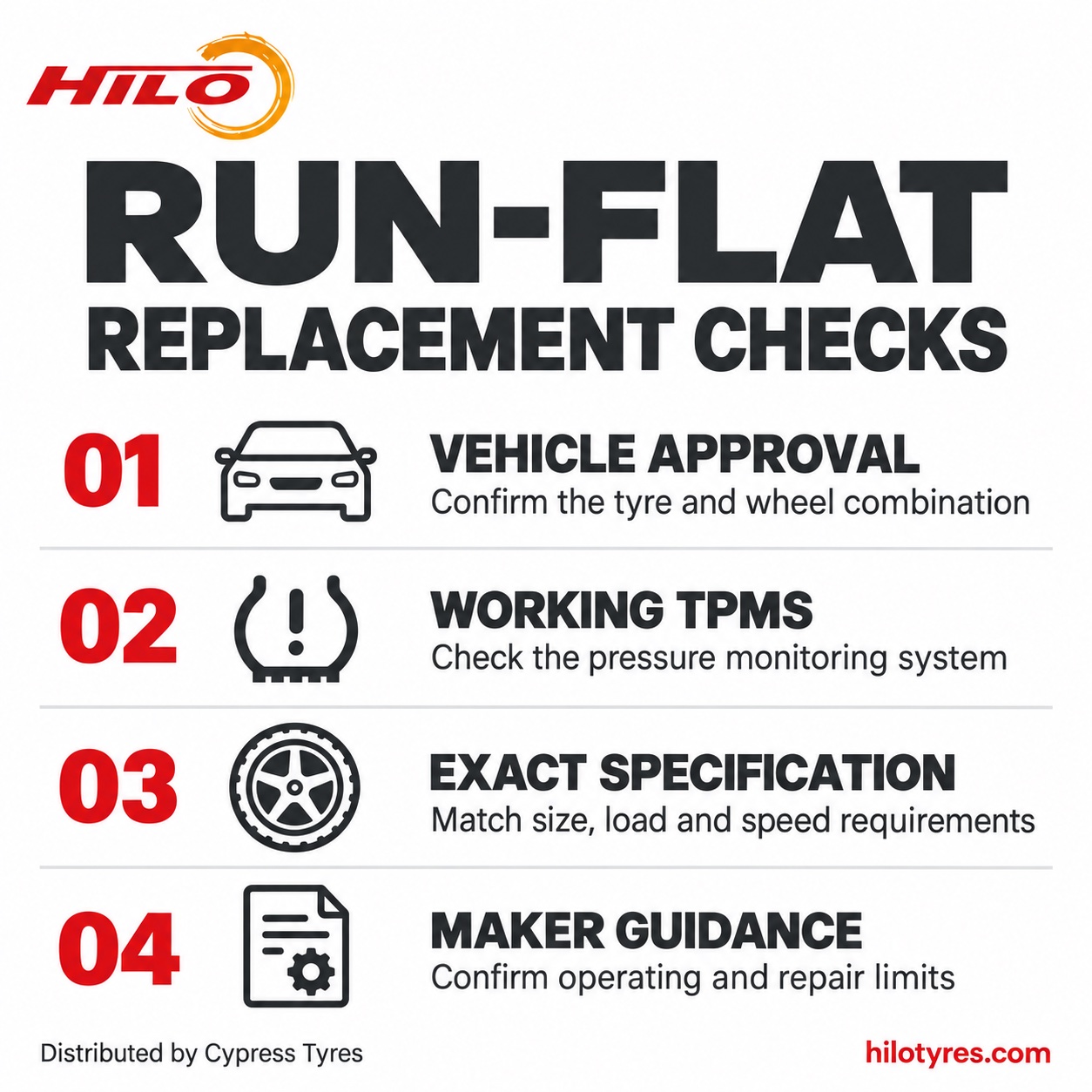
Five checks before buying replacements
1. Confirm the vehicle’s tyre requirements
Use the vehicle handbook and tyre placard, then have the proposed fitment checked by a qualified tyre professional. Include the vehicle variant and year when asking for advice. If wheels or other relevant parts have been changed, mention that too.
This is particularly useful when comparing online listings. A product name or vehicle-brand reference is less precise than a confirmed specification for your own car.
2. Record the complete sidewall markings
Photograph the size, load index, speed symbol and any run-flat designation on the tyres currently fitted. Include both axles if the specifications differ. Treat those photographs as information for the fitter, not proof that an earlier owner selected the correct tyres.
Our guide to tyre sidewall numbers and markings will help you identify the basic specification before making an enquiry.
3. Check the proposed tyre and wheel combination
Ask the fitter to verify the actual combination, including the vehicle manufacturer’s requirements. Run-flat terminology and markings can differ between manufacturers, so a seller’s broad category label should not be the only check.
For example, Michelin’s run-flat guidance includes specific wheel and vehicle-approval requirements for its products. That illustrates why another brand’s instructions should not automatically be treated as HILO instructions.
4. Get the operating and repair guidance
Ask for the instructions for the exact tyre before you need them. They should clarify what to do following a pressure warning and which limits apply. Keep the relevant vehicle and tyre information accessible with your roadside-assistance details.
Do not substitute a commonly quoted distance or speed from another brand. If the information for the proposed product is unclear, have it confirmed before making the purchase.
5. Confirm supply and the complete fitted cost
Ask whether your exact specification is available locally, when it can be fitted and what the quote includes. Check balancing, disposal and any TPMS-related work rather than assuming everything is covered by the tyre-only price.
For a fair cost comparison, use our guide to judging tyre value beyond the purchase price. Keep suitability first, then compare the complete job.
What to do after a pressure warning
Follow the vehicle handbook and the instructions for the fitted tyre. If you are unsure whether continued driving is permitted, stop somewhere safe and contact roadside assistance or a tyre professional. Do not continue solely because you believe the car has run-flats.
When arranging an inspection, explain when the warning appeared and how far you travelled afterwards. Mention any unusual vibration, impact or visible damage. That information gives the workshop a clearer starting point than simply reporting a puncture.
Plan for access to help before a long journey. In Australia, the next tyre workshop may be some distance away; a limited mobility feature should not be your whole roadside plan. Check who you would call and whether they can support the route you intend to take.
Can run flat tyres be repaired?
There is no single repair promise that applies to every run-flat. The tyre’s condition and the manufacturer’s policy matter. Michelin, for example, permits repair of its run-flat products only under specified inspection conditions; that policy cannot be transferred to a different manufacturer.
Have a qualified workshop assess the tyre and apply the relevant guidance. Do not book a guaranteed repair based only on the size of a visible puncture. Ask what the inspection will involve and whether replacement may be necessary so you understand the possible next steps.
Where HILO SAFETY XF8 fits
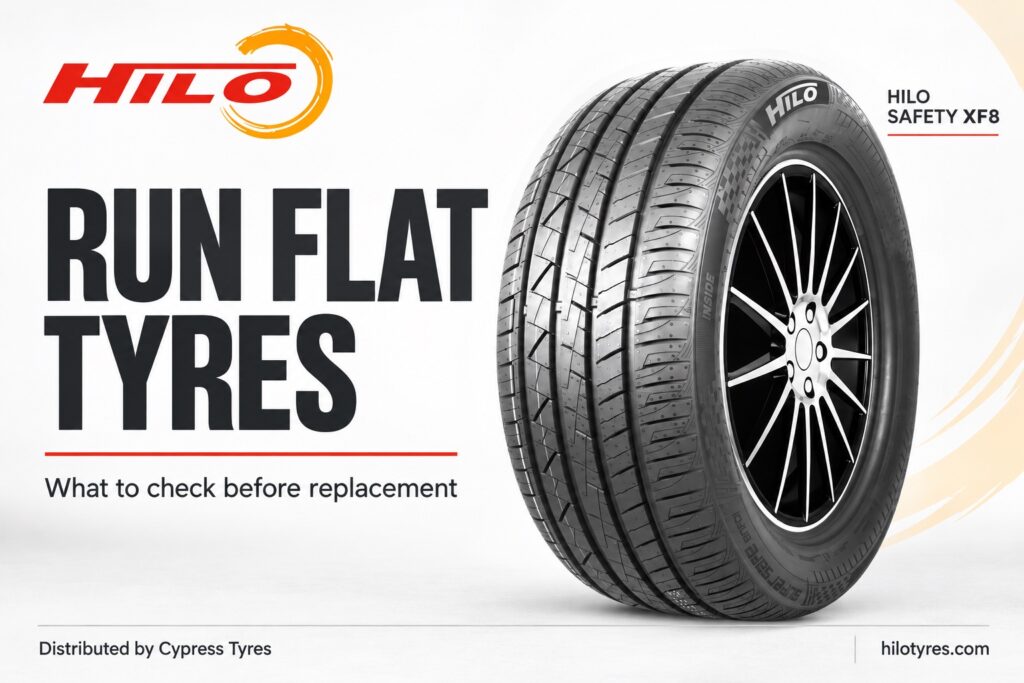
SAFETY XF8 is HILO’s listed run-flat pattern. Its Australian product page describes reinforced sidewall construction, specifies a TPMS requirement and provides a table of sizes and specifications. Review the HILO SAFETY XF8 run-flat specifications when preparing your enquiry.
The page is a starting point for fitment and supply checks. It does not publish a model-specific distance-and-speed guarantee for driving after deflation, so this guide does not assign one. Ask for the applicable instructions for the exact tyre you are considering.
To discuss availability, contact a HILO stockist with your vehicle details, full tyre specification and suburb. HILO is distributed in Australia by Cypress Tyres; current stock should be confirmed when you enquire.
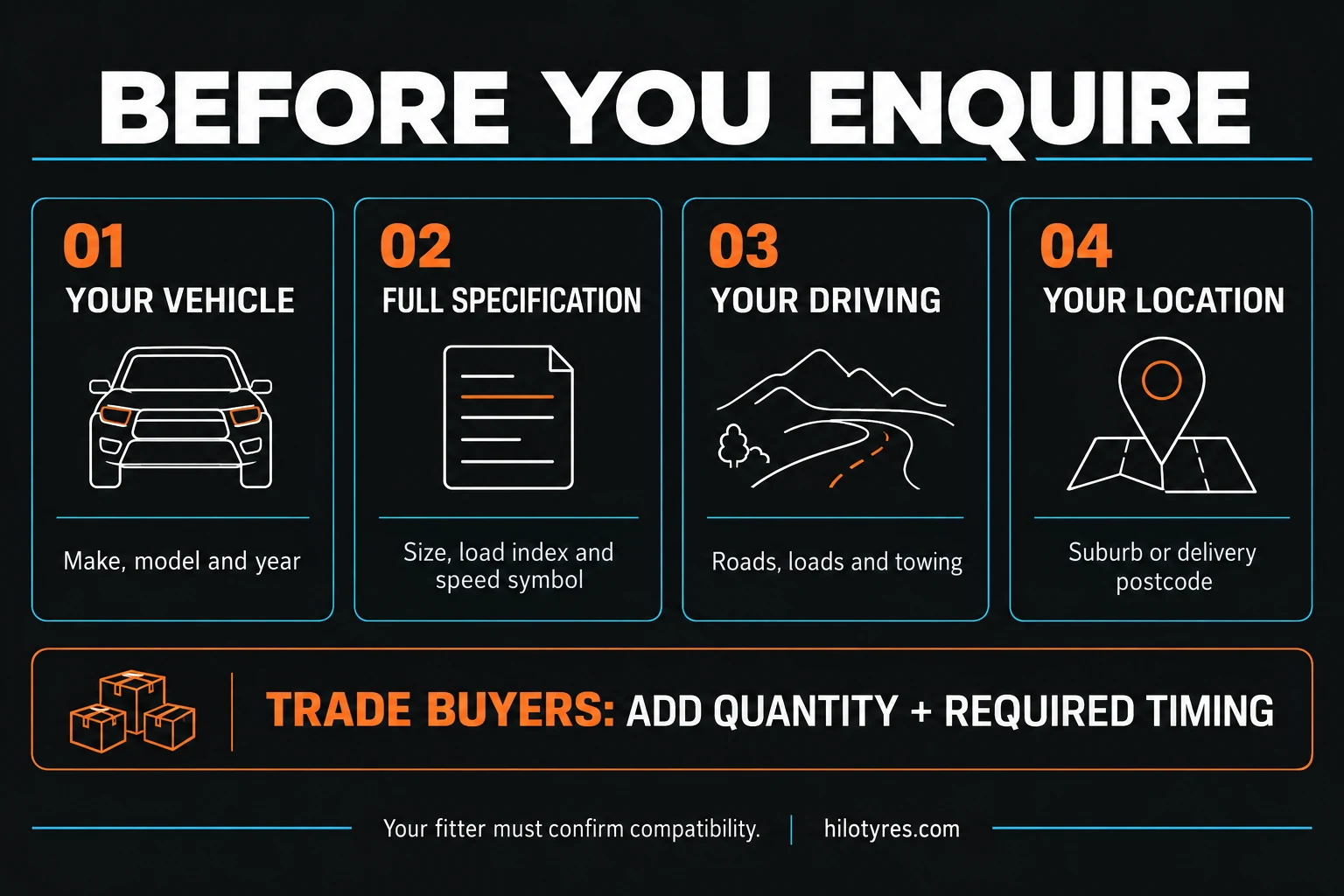
SAFETY XF8 documentation card
Complete this card with your fitter before ordering. The XF8 product page provides published specifications, but does not replace the operating and repair instructions for your exact tyre and vehicle.
| Item | Record or obtain | Current evidence boundary |
|---|---|---|
| Vehicle and wheels | Make, model, year, variant, placard and wheel details | Fitter must confirm the proposed combination |
| Exact tyre | Full XF8 size, load index, speed symbol and run-flat marking | Match one complete product-table entry; include both axles if different |
| Monitoring system | TPMS compatibility, working status and required service/reset | A product category alone does not verify your vehicle system |
| Pressure-loss operation | Applicable manufacturer document, version and conditions | No XF8-specific distance or speed limit established by this guide |
| Inspection and repair | Manufacturer policy and qualified inspection findings | Do not transfer another brand’s repair permission to XF8 |
| Supply and fitting | Written quote for the exact specification | Catalogue presence is not current stock confirmation |
Review date: 21 September 2026. Where the applicable operating or repair document is missing, request it before relying on a capability. Use the stockist enquiry to ask for assistance; business buyers can use the trade enquiry.
Run-flat tyre questions
Can I replace run flat tyres with normal tyres?
Do not treat it as a simple like-for-like price choice. Have the vehicle manufacturer’s requirements and the complete replacement arrangement checked first, including how you would handle a puncture afterwards. Avoid mixing conventional and run-flat tyres on the vehicle.
Can I put run-flats on a car that did not come with them?
Do not assume compatibility. Check vehicle and wheel suitability and the monitoring requirements with a qualified fitter before ordering. Matching the size is only part of the decision.
How far can I drive on a punctured HILO SAFETY XF8?
Use the instructions supplied for the exact tyre and vehicle. The current product page does not state a specific deflated-running distance or speed; a number quoted for another brand is not a HILO guarantee.
Do run flat tyres still need pressure checks?
Yes. They require proper inflation in everyday use. Follow the vehicle’s pressure guidance and normal tyre checks rather than relying on the tyre’s emergency capability.