If your SUV spends most of its time commuting, doing the school run and travelling on sealed highways, highway terrain tyres belong on your shortlist. H/T means highway terrain: a tyre category aimed primarily at road use. The right choice still depends on your vehicle’s specifications and the conditions you actually drive in.
Start with a simple question: what will the next set of tyres spend an ordinary week doing? A family SUV that rarely leaves bitumen has a different job from a 4WD that regularly tackles rough tracks. Choosing around that everyday job makes the buying decision clearer.
What are highway terrain tyres?
Highway terrain tyres are designed with paved-road driving in mind. All-terrain, or A/T, tyres cover a broader mix of road and off-road use, while mud-terrain tyres focus more heavily on demanding off-road conditions. These categories describe the intended use; they are not a ranking of overall quality.
The distinction is also about the difficulty of the terrain, not simply how often you leave the highway. A short stretch of a badly damaged track can demand more from a tyre than a much longer drive on a maintained unsealed road. Toyo’s explanation of terrain categories makes this useful distinction between time off-road and the conditions encountered.
H/T therefore gives you a starting point. You still need to compare the actual tyre model, construction and specification.
Start with the journeys you make most
City commuting and family driving
For a vehicle used mainly on sealed streets, make a shortlist around correct fitment, wet-road performance information, ride quality and the complete fitted price. An aggressive-looking tread is not, on its own, a reason to choose a tyre.
Think about your current set, too. Are you replacing it because the tread has worn out, or because the car has become noisy or uncomfortable? Tell the fitter what has changed. Ask for the tyre condition and vehicle setup to be checked before assuming a different tread category will solve the problem.
Highway trips with passengers and luggage
A road trip adds a practical question: what will the vehicle be carrying? Bring the vehicle’s tyre placard information and explain your typical load when requesting a recommendation. If you tow, include that in the conversation rather than treating “suitable for an SUV” as sufficient detail.
Before paying, ask which exact size and load specification the quote covers. Two offers for the same pattern name may not be for the same specification. Keep the comparison like for like.
Occasional unsealed roads
Describe the route rather than just saying “a bit of off-road driving”. Is it a maintained access road, loose gravel, sharp rock or a muddy track after rain? Ask whether the proposed tyre suits that use and what its limitations are.
If rougher routes are becoming a regular part of your driving, widen the shortlist. Our rugged-terrain versus all-terrain guide covers that separate decision. There is no need to choose a more specialised off-road tyre solely for its appearance, but the difficult parts of your route should not be ignored either.
H/T or A/T: make the comparison specific
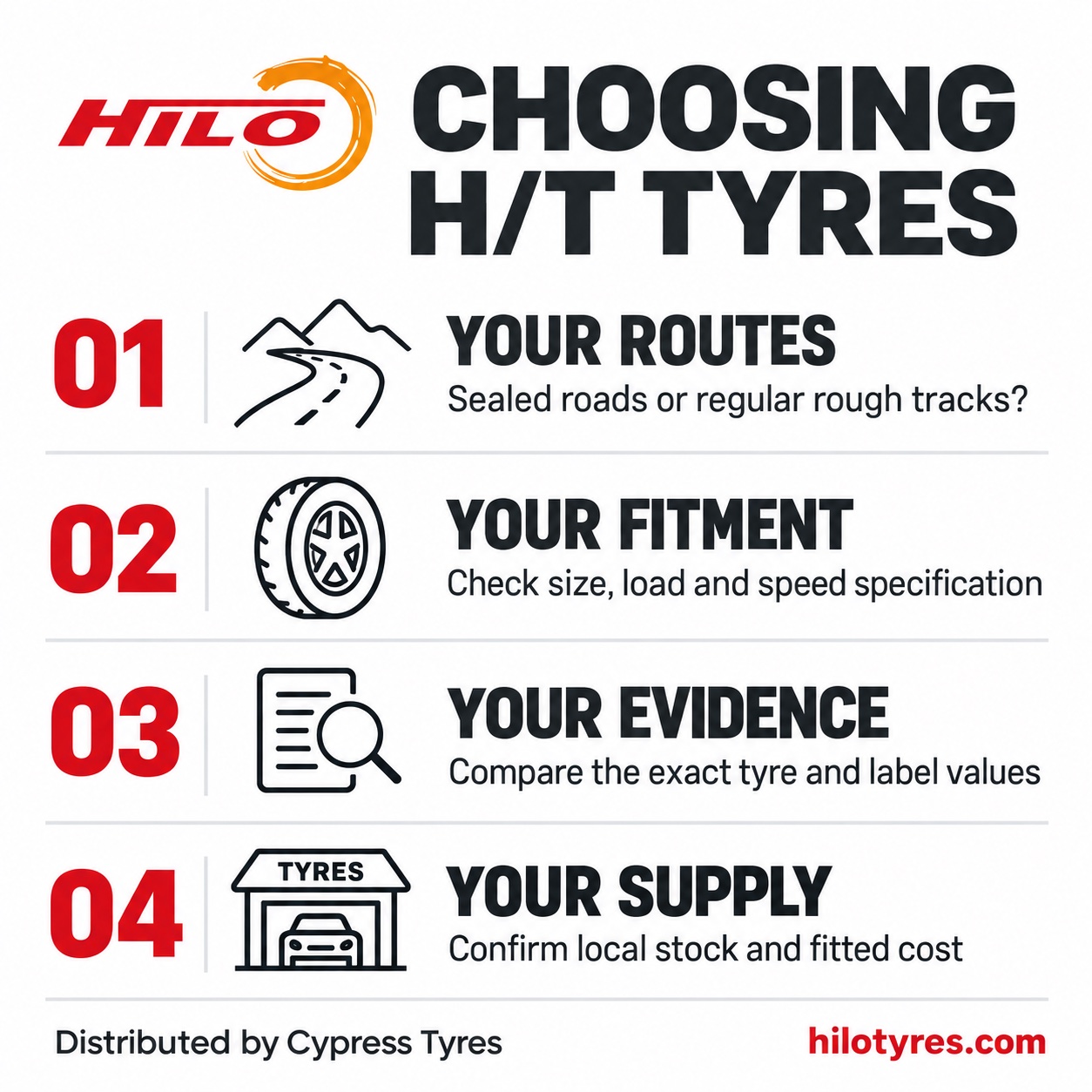
Put your actual requirements next to each candidate tyre:
- Road use: Which journeys dominate your week, and what would you most like to improve?
- Unsealed use: What surfaces and conditions must the tyre cope with?
- Fitment: Is the exact size and specification suitable for the vehicle?
- Evidence: Are there size-specific label values or relevant tests, rather than only broad marketing claims?
- Support: Can a local fitter supply the right replacement and explain the total cost?
This approach is more useful than assuming every H/T is quieter than every A/T, or that every A/T is automatically the better purchase. Compare named products against the job you need them to do.
How to read wet-grip and noise information
Where a product lists EU tyre-label information, use it carefully. The label covers rolling resistance, wet grip and external rolling noise. External noise is measured outside the vehicle; it is not a measurement of the sound you will hear in your cabin. The European Commission’s tyre-label guide explains the three measures.
Look up the row for your proposed size and specification. Do not take a favourable value from another size in the same range and assume it applies to your quote. If a value is missing, ask for confirmation rather than treating the blank as a performance claim.
Labels can inform a comparison, but they do not answer every question about comfort, wear or use on your particular roads. Ask what evidence supports any claim that one option will perform better for you.
Where the HILO SPORT XV1 fits
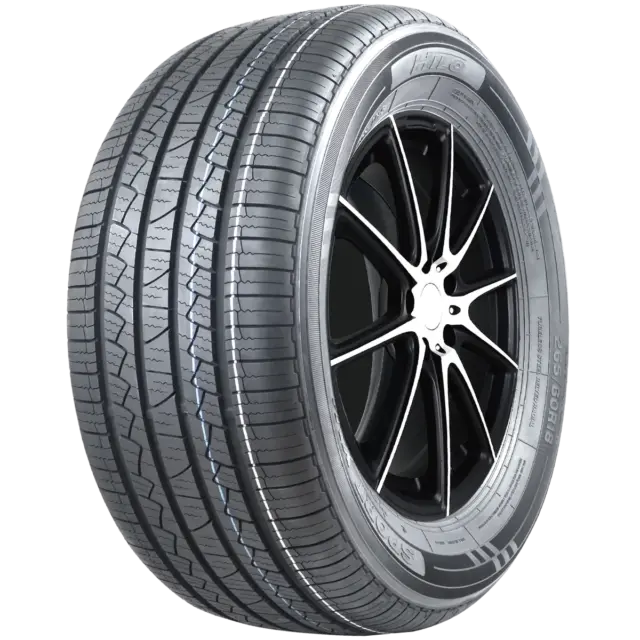
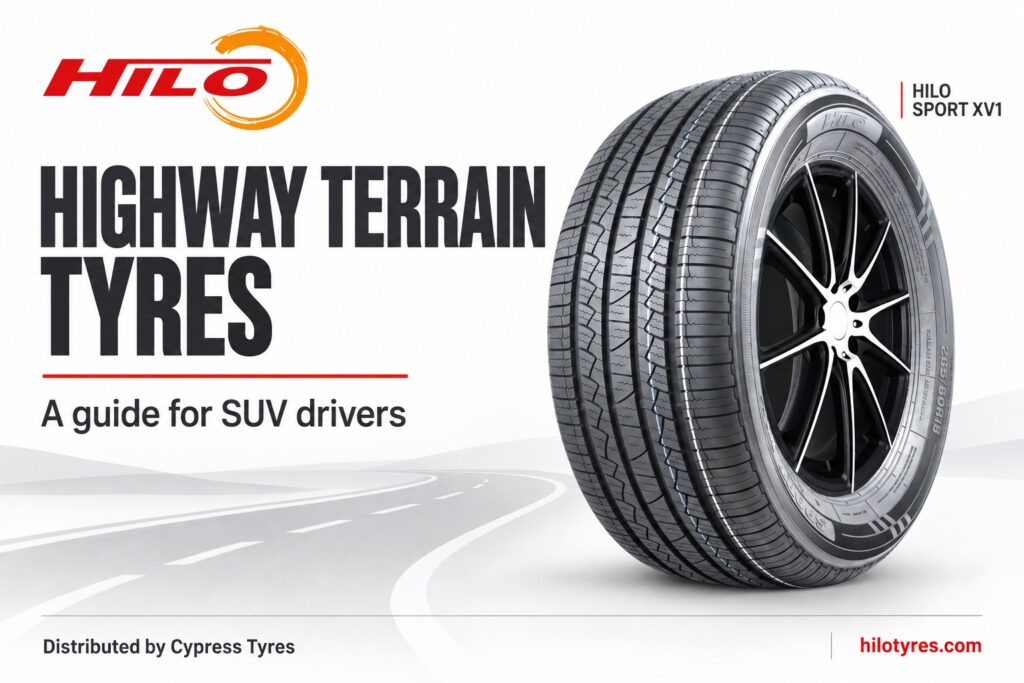
The HILO SPORT XV1 is listed in the Australian range as an SUV H/T pattern. Its product page provides a size-by-size specification table, including load and speed information and available tyre-label values. Use the HILO SPORT XV1 sizes and specifications to prepare a focused enquiry.
For example, send the fitter the complete specification you need and ask them to confirm the corresponding catalogue entry. A matching rim diameter alone is not enough information to order a tyre. Our guide to reading the numbers on your tyre sidewall explains how those details are written.
The product page also notes that Australian availability varies. A catalogue listing is a useful reference, not confirmation that a particular size is in stock today.
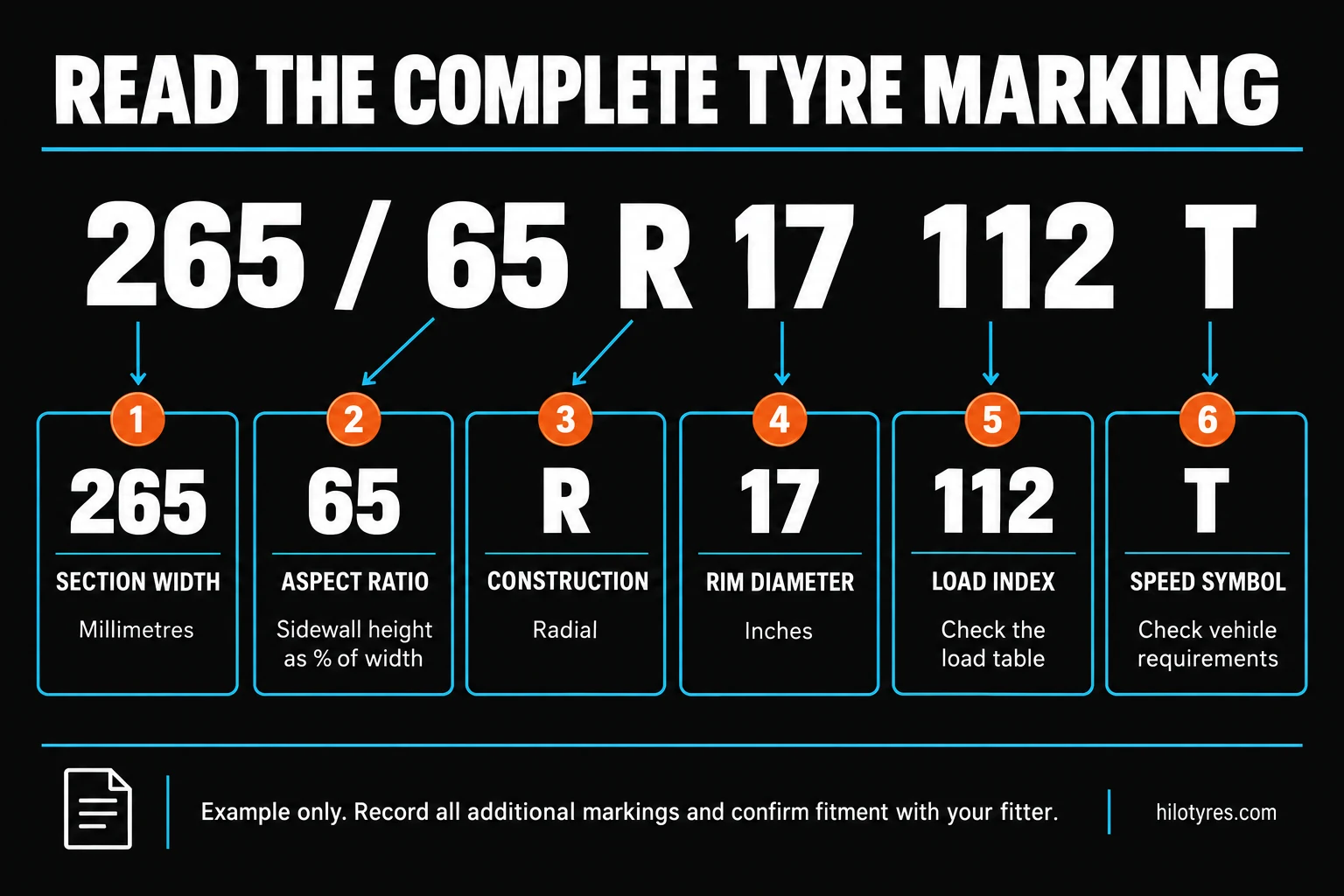
In the example 265/65 R17 112T, 265 is nominal section width in millimetres; 65 is the aspect ratio (sidewall height as a percentage of width); R denotes radial construction; 17 is rim diameter in inches; 112 is the load index; and T is the speed symbol. Record the complete marking and confirm the required specification with your vehicle placard and qualified fitter.
Your H/T or A/T requirements worksheet
Copy these prompts into your enquiry or notes. There is no fixed percentage of off-road driving that selects a tyre for every SUV.
| Prompt | Your notes |
|---|---|
| Vehicle, year and variant | ________________ |
| Front and rear full tyre specifications; placard requirements | ________________ |
| Typical sealed journeys and approximate distance | ________________ |
| Unsealed surface and condition; how often; seasonal changes | ________________ |
| Usual passengers, cargo and towing | ________________ |
| Priorities and problems with the current tyres | ________________ |
| Candidate pattern and complete catalogue entry | ________________ |
| Evidence requested: exact-size labels or relevant tests | ________________ |
| Location, quantity and required timing | ________________ |
Use the SPORT XV1 specification table for the H/T candidate. If A/T is relevant, compare the X-TERRAIN XT1 table. The pages identify catalogue2025.12 as their specification source. Confirm the exact entry with your fitter; this worksheet is not fitment approval or a comparative test.
What to send with your tyre enquiry
Include your vehicle make, model and year, a clear photo of the tyre placard, the current tyre markings and your suburb. Mention towing, regular heavy loads or unsealed routes. If the front and rear tyres differ, include both specifications.
Ask for a quote that identifies the exact tyre and explains fitting, balancing, disposal and any other charges. A clear written quote helps you compare the full job rather than a headline price. For more on that comparison, read how to judge tyre value beyond the price tag.
Ready to check an H/T option? Find a HILO stockist near you and ask about the correct SPORT XV1 specification for your vehicle.
Highway terrain tyre questions
What does H/T mean on tyres?
H/T means highway terrain. It describes the tyre’s intended road-use category. It does not replace the size, load and speed information needed to check fitment.
Do I need all-terrain tyres because my SUV has AWD?
AWD alone is not enough to decide the tyre category. Base the shortlist on the vehicle requirements and your routes, then have the exact fitment confirmed.
Are highway terrain tyres suitable for every gravel road?
Do not assume so. Tell your fitter about the surface, condition and frequency of use. A maintained access road and a rough rocky track are different requirements.
Are H/T tyres always the quietest choice?
Avoid judging cabin comfort from the category alone. Compare the specific products, and remember that an external noise label is not an in-car noise test.