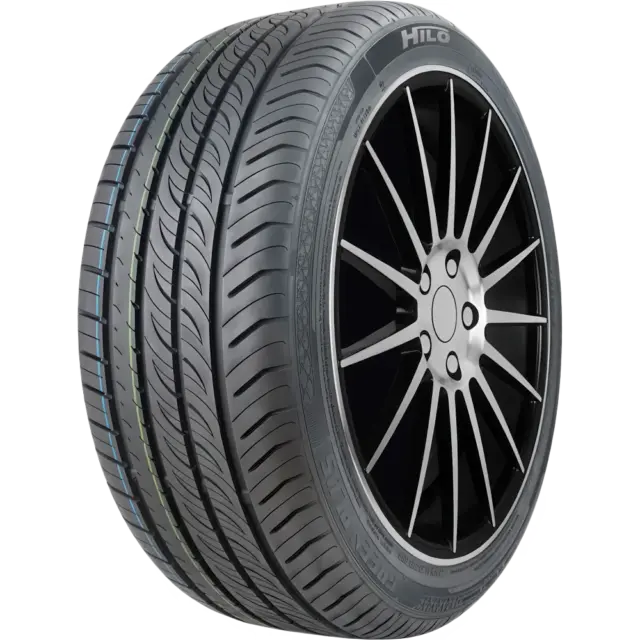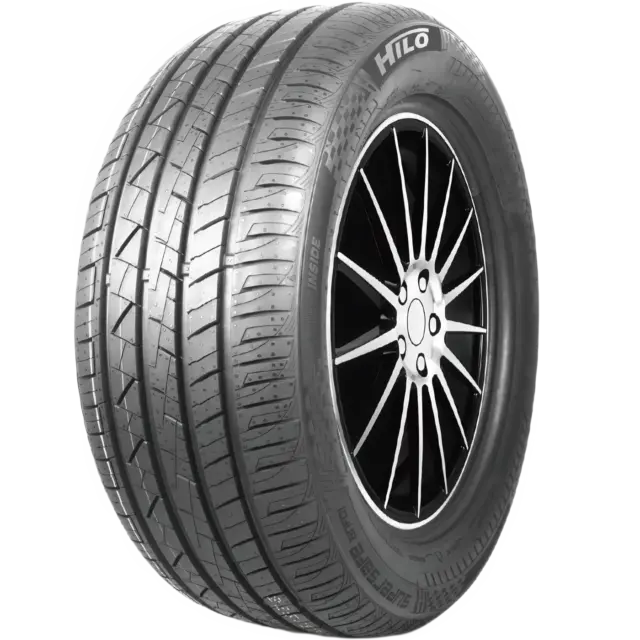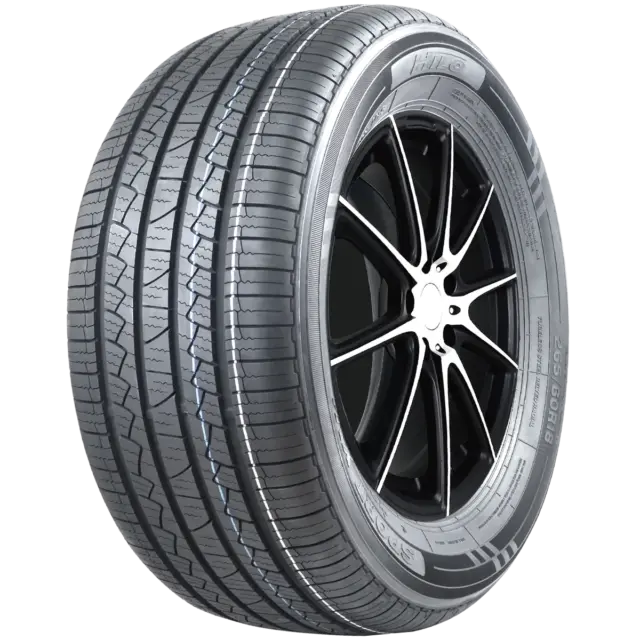
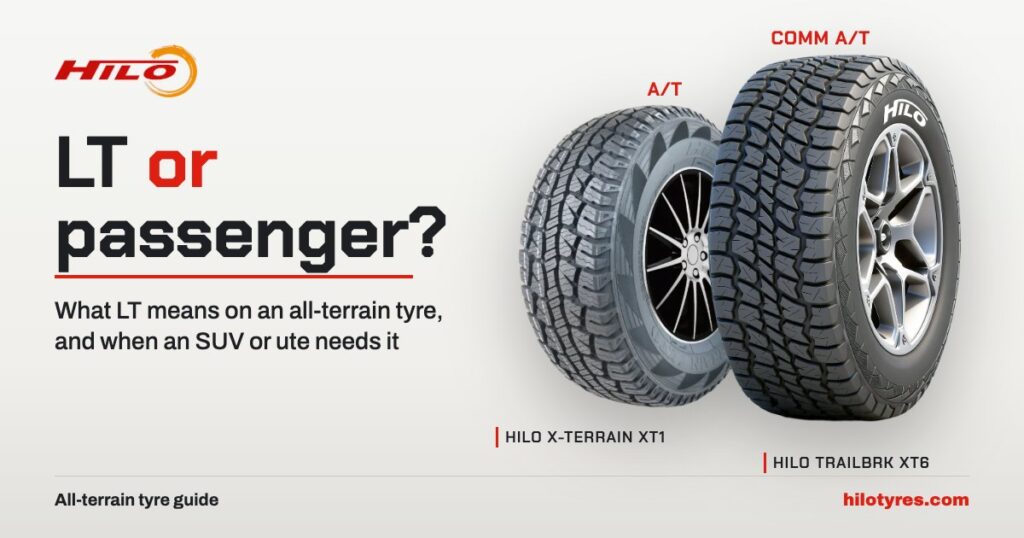
An LT all-terrain tyre is an all-terrain tread built in light truck construction. You can spot one by the LT in the size (LT265/75R16, or 31X10.50R15LT), a ply rating and, on most sizes, two load index numbers. In HILO’s tables, LT entries list more load capacity and a higher maximum pressure than passenger-construction entries of the same size. Whether an SUV or ute needs one depends on its placard, its loads and its work, not on how aggressive the tread looks.
This guide explains the markings, shows the difference using HILO’s own specification tables, and sets out what a tyre shop should check before recommending LT over passenger construction.
How to tell an LT tyre from a passenger tyre
The size and service description tell you most of what you need. Our guide to reading tyre sidewall numbers covers the basics. For construction, look for these markings:
- LT in the size. Either as a prefix (LT285/75R16) or after a flotation size (33X12.50R17LT). Commercial sizes such as 205R16C are listed by HILO as LT entries too.
- Two load index numbers. Most metric LT entries carry a pair such as 123/120. The European Commission’s tyre-parameter guide explains the format: the first figure is the load per tyre in single fitment, the second the load per tyre in dual (twin) fitment.
- A ply rating. HILO’s 4×4 and all-terrain tables show 6PR, 8PR or 10PR for LT entries. Passenger entries show no ply rating.
- XL or “Extra Load” on a passenger tyre. Transport for NSW describes REINFORCED or EXTRA LOAD tyres as designed for heavier loads than a standard tyre of the same size. An XL passenger tyre is still passenger construction, not LT.
Same size, different construction: three examples
HILO lists several sizes in both passenger and LT construction, across different patterns. Comparing them shows what the LT markings mean in practice.
| Entry | Load index / speed | Ply | Max load (single) | Max pressure |
|---|---|---|---|---|
| SPORT XV1 265/75R16 (H/T) | 116H | – | 1,250 kg | 350 kPa |
| X-TERRAIN XT1 LT265/75R16 (A/T) | 123/120R | 10PR | 1,550 kg | 550 kPa |
| X-TERRAIN XT1 265/70R17 (A/T) | 115T | – | 1,215 kg | 350 kPa |
| X-TERRAIN MT1 LT265/70R17 (M/T) | 121/118Q | 10PR | 1,450 kg | 550 kPa |
| X-TERRAIN XT1 245/70R16 (A/T) | 107T | – | 975 kg | 350 kPa |
| X-TERRAIN XT1 245/70R16 XL (A/T) | 111T XL | – | 1,090 kg | 340 kPa |
| TRAILBRK XT6 LT245/70R16 (COMM A/T) | 113/110S | 8PR | 1,150 kg | 450 kPa |
The table shows three differences. The LT versions carry more load per tyre. They list a higher maximum pressure. And they usually carry a lower speed symbol: in the European Commission’s speed table, Q is 160 km/h, R is 170 km/h, S is 180 km/h, T is 190 km/h and H is 210 km/h.
The higher maximum pressure is not a running pressure. Queensland’s Department of Transport and Main Roads (TMR) points out that the maximum pressure on a sidewall is the pressure needed to carry the tyre’s maximum load, and is not always the vehicle manufacturer’s recommended pressure.
Ply rating and maximum pressure in the XT1 range
In the X-TERRAIN XT1 specification table, ply rating and listed maximum pressure line up consistently:
| XT1 construction | Entries | Listed max pressure |
|---|---|---|
| Passenger (no ply rating) | 9 | 340 or 350 kPa |
| LT 6PR | 4 | 350 kPa |
| LT 8PR | 2 | 450 kPa |
| LT 10PR | 9 | 550 kPa |
Do not assume that pattern carries across every range. HILO’s MT1 table, for example, lists some 8PR sizes at 350 kPa and some 10PR sizes at 450 kPa. Always read the row for the exact entry. Some sizes also come in two LT versions. XT1 lists LT235/75R15 as 104/101R 6PR and as 110/107S 8PR, so quote the ply and load index, not just the size.
HILO all-terrain options in LT construction
X-TERRAIN XT1 (SUV A/T)
XT1 lists 24 entries: 15 in LT construction on 15 to 17-inch rims and 9 in passenger construction on 16 to 20-inch rims. HILO describes it as an all-terrain pattern for routes that include sealed and unsealed roads. The LT entries are:
| Size | Load index / speed | Ply | Max load (single/dual) |
|---|---|---|---|
| 31X10.50R15LT | 109R | 6PR | 1,030 kg |
| LT215/75R15 | 100/97S | 6PR | 800/730 kg |
| LT225/75R15 | 102/99S | 6PR | 850/775 kg |
| LT235/75R15 | 104/101R | 6PR | 900/825 kg |
| LT235/75R15 | 110/107S | 8PR | 1,060/975 kg |
| 205R16C (LT) | 110/108R | 8PR | 1,060/1,000 kg |
| LT215/85R16 | 115/112R | 10PR | 1,215/1,120 kg |
| LT225/75R16 | 115/112R | 10PR | 1,215/1,120 kg |
| LT235/85R16 | 120/116R | 10PR | 1,400/1,250 kg |
| LT245/75R16 | 120/116R | 10PR | 1,400/1,250 kg |
| LT245/85R16 | 121/118Q | 10PR | 1,450/1,320 kg |
| LT265/75R16 | 120/117R | 10PR | 1,400/1,285 kg |
| LT265/75R16 | 123/120R | 10PR | 1,550/1,400 kg |
| LT285/75R16 | 121/118Q | 10PR | 1,450/1,320 kg |
| LT285/70R17 | 121/118Q | 10PR | 1,450/1,320 kg |
TRAILBRK XT6 (COMM A/T)
HILO describes TRAILBRK XT6 as an all-terrain pattern in light truck construction for utes and vans that work off sealed roads but still need a high load rating. It lists 11 sizes: 9 LT entries from 16 to 20 inches (6PR to 10PR, all S speed symbol) and two passenger XL sizes in 19-inch.
Wanting something more aggressive?
For customers asking for an “aggressive all-terrain”, the next step up in the HILO range is WILDGRIP RT1, a rugged-terrain pattern. 18 of its 24 entries are LT or flotation sizes, from 6PR to 10PR. Our R/T vs A/T guide explains where R/T sits between A/T and mud-terrain, and the MT1 guide covers the dedicated mud option.
When does an SUV or ute need LT construction?
Start with the vehicle, not the tread.
- Read the placard. Transport for NSW’s guideline on alternative wheels and tyres says replacement tyres must have a load rating equal to or higher than the original tyres, and a speed rating that is generally equal or higher. If the placard calls for an LT or C tyre, stay with LT or C construction unless the vehicle manufacturer says otherwise.
- Check the speed symbol. Many LT entries are Q, R or S rated. The NSW guideline allows a lower speed rating than the placard only where the placard rating is above 180 km/h, never below the vehicle’s top speed, and recommends a warning label in that case. Other states publish their own rules.
- Ask about the work. Towing, carrying a fit-out or tray load, and remote touring on rough roads are reasons to discuss LT construction with the customer. A family SUV that rarely leaves sealed roads may be better served by a passenger-construction A/T or an H/T tyre. Our H/T or A/T guide walks through that decision.
- Explain the trade-offs. Our R/T vs A/T guide notes that weight and rolling resistance may increase with aggressive LT fitments. Make sure the customer knows that before they choose LT for looks alone.
- Plan the pressure. If the fitted tyre differs from the placard tyre in construction or size, ask for the load and pressure data for the fitted tyre rather than copying the placard figure across.
What to record before you quote
- The placard’s tyre size, load index and speed symbol.
- The full description on the current tyres, including LT, C or XL markings and ply rating.
- How the vehicle is used: towing, payload, fit-out and off-road surfaces.
- Wheel size and rim width, checked against the standard rim listed for the tyre.
- Quantity, delivery postcode and the date you need the tyres.
Our trade checklist for BRAWN XC1 van tyres uses the same approach. When you are ready, send the full specification through the HILO trade enquiry form. Availability, trade pricing and delivery are confirmed for the exact entry you request.
Frequently asked questions
What does LT mean on a tyre?
Light truck. LT tyres carry a ply rating and usually two load index numbers, one for single fitment and one for dual fitment, and HILO’s tables list higher maximum pressures for them than for passenger tyres of the same size.
Are LT all-terrain tyres suitable for an SUV?
They can be, if the load index and speed symbol meet the placard requirements and the vehicle’s use justifies the heavier construction. If the SUV mostly stays on sealed roads, a passenger-construction A/T or H/T tyre may suit it better. Check with a tyre professional.
What tyre pressure should I run in all-terrain tyres?
Use the vehicle’s tyre placard or owner’s manual for the tyres the manufacturer specified, measured cold. The maximum pressure moulded on the sidewall is not a running pressure. If you have changed to LT construction or a different size, ask your tyre professional to set pressures from the fitted tyre’s load data.
Can I put all-terrain tyres on my van?
Possibly, if the size, load index and speed symbol match the van’s placard. HILO’s X-TERRAIN XT1 lists a 205R16C (LT) entry, and TRAILBRK XT6 is described as an all-terrain pattern for utes and vans. Confirm the exact entry against the placard first.