There is no fixed kilometre figure for how long tyres last. A tyre is finished when the tread reaches the legal minimum of 1.5 mm, when it is damaged, or when the rubber has aged and cracked, whichever comes first. How quickly that happens depends mostly on maintenance: tyre pressure, wheel alignment and balance, rotation, and the load the vehicle carries. The roads, how often the vehicle is driven and the weather also play a part.
Customers ask this question at the counter more than almost any other. This guide gives tyre shops and workshops a straight answer they can stand behind, with the official sources, and ends each section with what to tell the customer.
Three things end a tyre’s life
1. Tread wear
Tread clears water from under the tyre, and as it wears, grip drops. The NSW Government’s roadworthiness rules say tyres must not be smooth and must have a tread at least 1.5 mm deep. Most tyres have tread wear indicators in the main grooves that show when the tread is down to about 1.5 mm. Queensland’s Department of Transport and Main Roads (TMR) says in its TyreSmart guidance that a tyre worn level with the indicator must be replaced immediately, and advises replacing tyres before they reach the minimum depth.
2. Damage
A tyre with plenty of tread can still be finished. TMR warns that tyres with deep cuts, cracks, blisters and bulges are dangerous and should be replaced. Damage is most likely after a hard hit on a pothole or kerb, after off-road driving, or after a tyre has run low on air.
3. Age
Rubber ages whether the vehicle is driven or not. SafeWork NSW lists “perishing on tyres more than five years old” among the defects to check for before a tyre is fitted. That makes age especially important for vehicles, caravans and trailers that do low kilometres: the tread can look fine while the rubber is cracking.
To find a tyre’s age, read the four-digit date code on the sidewall. Transport for NSW’s guidelines for alternative wheels and tyres give the example “3015”, meaning week 30 of 2015.
What to tell the customer: “Your tyres last until the tread is down to the limit, they’re damaged, or the rubber starts cracking, whichever comes first. How you look after them decides how soon that is.” Then show them their own tread depths and date codes.
What shortens tyre life
| Cause | What it does | What to do |
|---|---|---|
| Wrong pressure | TMR calls incorrect inflation “the number one enemy of a tyre”. Over-inflation wears the centre of the tread. Running too low can increase heat and sidewall flex. | Check monthly, when the tyres are cold, against the vehicle’s tyre placard. |
| Poor wheel alignment | Excessive wear on the tyre edges. The steering may pull to one side. | TMR suggests an alignment check at least once a year. |
| Wheels out of balance | Uneven wear (bald spots) and a pounding or shaking through the wheel or seat. | Check the balance if the customer reports vibration. |
| No rotation | Front and rear tyres wear differently, especially on front-wheel drive vehicles. | Rotate as the vehicle manufacturer recommends. |
| Overloading or low pressure under load | SafeWork NSW warns that running below 80% of recommended pressure, or overloading, can lead to fatigue failures in the sidewall. | Stay within the load rating and pressures the placard specifies. |
| Roads, use and weather | TMR notes tyre health is affected by the roads driven on, how often the vehicle is driven, the weather and unexpected hazards. | Inspect more often on rough or unsealed roads. |
Our mud-terrain guide explains why excessive deflation off-road can increase heat and sidewall flex, and our sidewall guide covers the load index and speed symbol.
What to tell the customer: most short tyre lives come down to pressure, alignment or no rotation. If the old set wore unevenly, fix the cause when you fit the new one.
Why the kilometre figures vary so much
Two drivers can fit the same tyre and get very different results. One checks pressures monthly, rotates on schedule and keeps the alignment right. The other runs a few psi low, never rotates and drives a vehicle that pulls to the left. The second set will wear unevenly and need replacing well before the tread is used up across the whole tyre.
The tyre itself matters too. Tread pattern, compound and construction differ between passenger, SUV/4×4 and commercial tyres, and between models. For a particular tyre, the maker’s information is the place to look. A single kilometre figure quoted online is at best a rough average, not a promise for a particular vehicle.
What to tell the customer: avoid quoting a kilometre figure you can’t back up. Point to the maintenance that makes the difference instead.
4WD, all-terrain and van tyres
The same three limits apply. What changes is the risk of early damage and the importance of load and pressure.
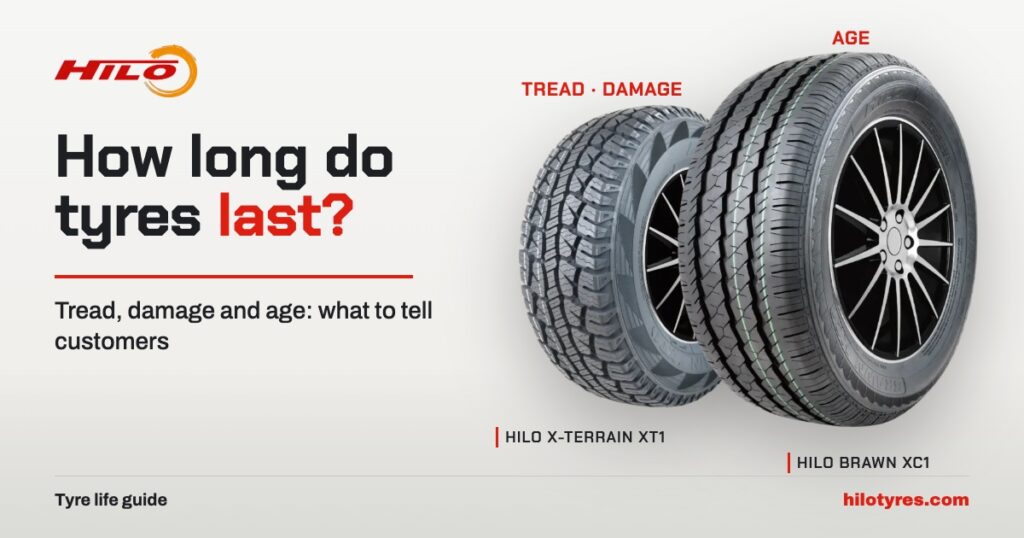
- Off-road: rocks and sticks expose the tread and sidewalls to damage, so inspect for cuts and bulges after every trip. Our guides to highway-terrain vs all-terrain and rugged-terrain vs all-terrain tyres help match the pattern to how the vehicle is used.
- Loads and towing: vans, utes and 4WDs often carry heavy loads or tow. Keep within the load rating and pressures on the placard, and check them cold.
- Vans: commercial van tyres work hard on load. Our BRAWN XC1 trade checklist covers what to record before ordering van tyres.
- Replacements: Transport for NSW says the load rating must be equal to or higher than the original tyres, and tyre types or sizes must never be mixed on an axle.
When to replace
Replace a tyre, or inspect it closely, when any of these apply:
- The tread is level with the wear indicators or close to 1.5 mm in the main grooves.
- There are cuts, cracks, blisters, bulges or exposed cords anywhere on the tyre.
- The tread has worn unevenly. Fix the cause (pressure, alignment or balance) at the same time.
- The rubber shows cracking or perishing from age, even if the tread looks deep.
- A tyre keeps losing pressure.
Fit a size listed on the tyre placard, with a load rating and speed rating at least equal to the original tyres. TMR also recommends the same type of tyre on all four wheels for proper handling. For vehicles on run-flat tyres, our run-flat guide sets out the extra checks.
How customers can get the most life from their tyres
- Check pressures once a month with a good gauge, when the tyres are cold, including the spare.
- Look over the tread and sidewalls at the same time.
- Rotate the tyres as the owner’s manual recommends.
- Have the alignment checked at least once a year, and sooner if the vehicle pulls or the tyres wear on one edge.
- Don’t overload the vehicle.
Ordering for your workshop
When a customer needs a new set, record the size, load index, speed symbol and how the vehicle is used. Check which HILO patterns come in that size with the size finder, compare the passenger, SUV and 4×4 and commercial ranges, and send the exact specification through the HILO trade enquiry form.
Frequently asked questions
How long do car tyres last?
Until the tread reaches the legal minimum of 1.5 mm, the tyre is damaged, or the rubber has aged and cracked, whichever comes first. Pressure, alignment, rotation, load and road conditions decide how quickly that happens, so there’s no single kilometre figure that fits every car.
How long should 4WD tyres last?
The same limits apply: tread depth, damage and age. Off-road driving, heavy loads and towing raise the risk of damage and faster wear, so inspect 4WD tyres after every trip and keep pressures and loads within the placard figures.
Do all-terrain tyres last longer?
It depends on the tyre and how it’s used, not the category. Tread compound, pattern and construction vary between models, so check the tyre maker’s information for the tyre in question, and look after pressure, alignment and rotation whichever type is fitted.
How long do tyres last on a van?
Van tyres wear out by the same rules: 1.5 mm minimum tread, no damage, no age cracking. Vans often run heavy, so correct load rating and pressure make a big difference. SafeWork NSW warns that overloading or running below 80% of recommended pressure can cause fatigue failures.
Do tyres expire if they’re not used?
Tyres don’t have a printed expiry date, but rubber ages over time. Check the four-digit date code on the sidewall and look for cracking. SafeWork NSW lists perishing on tyres more than five years old among the defects to check for.